


Every January, CES (Consumer Electronics Show) in Las Vegas sets the tone for the year ahead in consumer technology. And in recent years, no category has commanded more floor space, more brand investment, or more buyer excitement than Mini LED televisions.
Mini LED has moved fast from a niche premium technology to the mainstream battleground where Samsung, LG, Sony, TCL, and Hisense are all competing aggressively. Each new CES brings a fresh wave of announcements — brighter panels, more dimming zones, better processing, and lower prices — that redefine what buyers can expect from the technology.
This guide covers what Mini LED actually is, why CES matters for tracking its development, what the major manufacturers have showcased at recent CES events, and — most importantly — what all of it means if you are thinking about buying a Mini LED TV right now.
Mini LED at a Glance: Mini LED is a backlighting technology for LCD panels that uses thousands of tiny LEDs instead of the traditional handful of large ones. More LEDs mean finer local dimming control, significantly higher peak brightness, deeper blacks, and better HDR performance — all at a lower cost than OLED. It is the middle ground between standard LED LCD and OLED, and it is where most of the TV market’s innovation is currently focused.
Table of Contents
What Is Mini LED Technology? The Full Explanation
To understand why CES Mini LED announcements matter, you need a solid grasp of how the technology works — and what its advantages and limitations genuinely are.
Mini LED technology continues to evolve rapidly, and you can explore a foundational explanation of display backlighting in this LCD technology overview on Wikipedia along with broader context in the LED-backlit LCD display article
How Traditional LED LCD Backlighting Works
Standard LCD TVs use a backlight — a layer of LEDs behind the liquid crystal display panel — to illuminate the image. Traditional full-array local dimming (FALD) TVs divide this backlight into zones that can be dimmed independently. A typical mid-range TV might have 50–200 dimming zones. The problem: a large dimming zone covering a bright star and dark sky will either blow out the star or grey out the blacks — known as blooming or haloing.
What Mini LED Changes
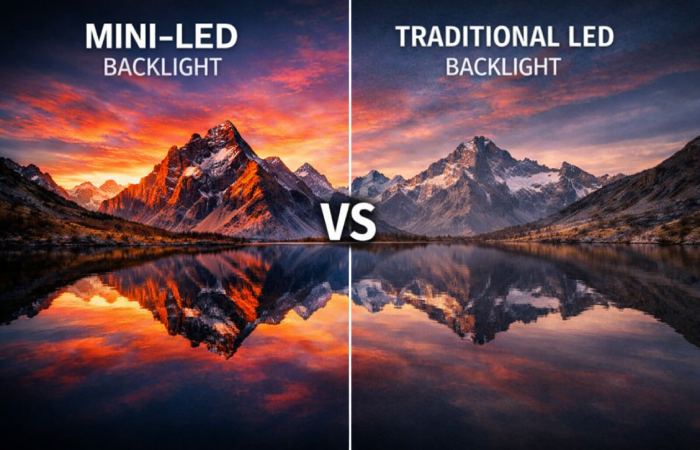
Mini LED shrinks the individual LEDs from around 1mm to 0.1–0.2mm in size. This smaller footprint means you can fit dramatically more LEDs into the same panel area — enabling thousands of independently controllable dimming zones instead of hundreds:
- More dimming zones: Premium Mini LED TVs from Samsung, TCL, and Hisense feature 1,000 to 5,000+ dimming zones. Some 2024–2025 flagship models push beyond 10,000 zones at the top end. More zones = more precise control = less blooming.
- Higher peak brightness: The density of Mini LEDs allows for significantly more light output. Premium Mini LED TVs routinely hit 2,000–4,000 nits peak brightness in HDR highlights — matching or exceeding OLED’s contrast visibility in bright room environments.
- Better HDR performance: HDR (High Dynamic Range) content is where Mini LED’s advantages are most visible. The combination of high peak brightness and fine local dimming delivers HDR highlights that are genuinely spectacular on well-implemented panels.
- Lower cost than OLED at large sizes: Manufacturing Mini LED panels at 75 inches and above remains significantly more cost-effective than OLED at equivalent sizes — which is why 85-inch and 98-inch Mini LED TVs are now available at prices that OLED simply cannot match.
Mini LED vs. OLED: The Honest Comparison
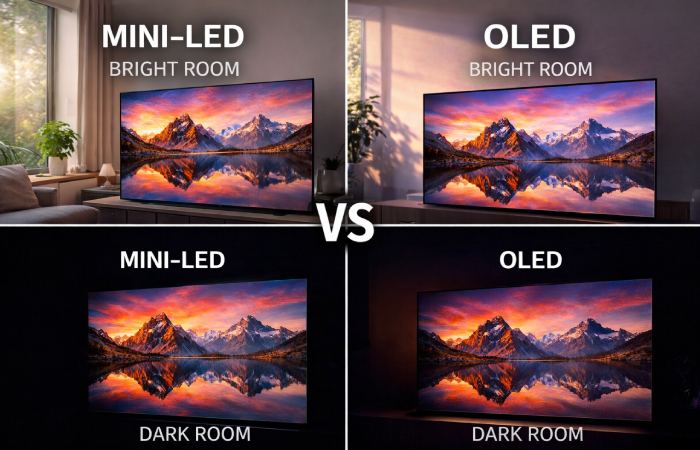
Mini LED and OLED are not fighting for the same ground — they have distinct strengths:
- OLED advantage: Perfect per-pixel black levels (LEDs turn completely off), infinite contrast ratio, faster pixel response, better viewing angles. OLED remains the best choice for dark room viewing and cinematic content.
- Mini LED advantage: Significantly higher peak brightness (better in lit rooms), no burn-in risk, larger sizes at lower prices, longer potential lifespan. Mini LED is often the better choice for living rooms with ambient light and sports/gaming use.
- The convergence: Manufacturers are attacking each other’s weaknesses — OLED panels are getting brighter (QD-OLED, WOLED with micro-lens arrays), while Mini LED zone counts are increasing rapidly. The gap is narrowing at the premium tier.
Why CES Is the Most Important Event for Mini LED TV Buyers
CES in January is not just a trade show — for TV buyers, it is effectively a preview of the entire year’s market. The announcements made at CES in January directly predict what you will be able to buy by spring and summer, and at what price points.
- New model announcements: Every major TV manufacturer uses CES to announce their flagship and mid-range lines for the year. CES is when you first learn about the specifications, features, and pricing tiers for models that will go on sale over the following months.
- Technology previews: Prototype technologies that are 12–24 months from commercial release are frequently shown at CES — giving buyers a sense of where the technology is heading and whether to buy now or wait.
- Competitive signaling: When Samsung announces a 5,000-zone Mini LED panel, LG responds with a competing specification, and TCL announces a value alternative — all in the same week. CES is where the competitive landscape for the entire year is drawn.
- Price trajectory signals: CES announcements reveal which tier each manufacturer is targeting and at what price point — invaluable for buyers deciding between current-generation deals and waiting for new models.
Major Brands and Their CES Mini LED Strategies
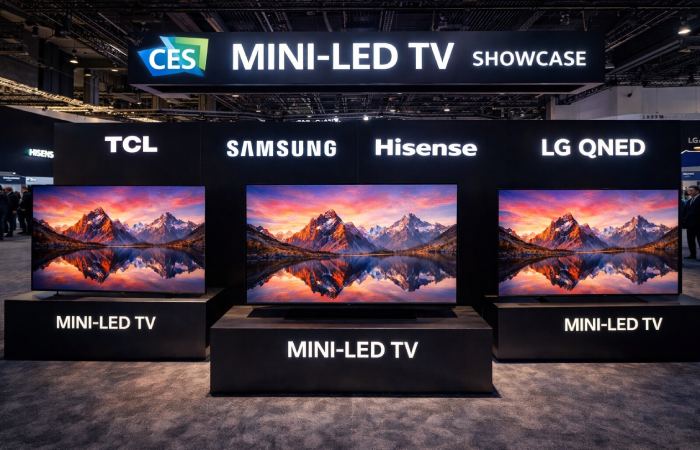
Here is how each of the major TV manufacturers has approached Mini LED at CES — their positioning, their technology focus, and what differentiates their approach.
Samsung: Neo QLED and Quantum Mini LED
Samsung coined the term Neo QLED for their Mini LED lineup and has consistently been at the forefront of CES announcements in this category. Samsung’s Mini LED strategy combines their Quantum Dot color layer with Mini LED backlighting — delivering wide color gamut alongside the brightness and dimming benefits of Mini LED.
At recent CES events, Samsung has showcased ever-increasing dimming zone counts, their Neural Quantum Processor for AI-based upscaling and scene optimization, and integration with their SmartThings ecosystem. Samsung’s Neo QLED range spans from accessible 4K models to flagship 8K panels at the top of the market.
Samsung’s particular strength in Mini LED is their processing — their image processors are widely regarded as among the best in the industry for motion handling, upscaling, and local dimming algorithm quality.
LG: QNED Mini LED
LG markets its Mini LED LCD lineup under the QNED brand — combining Quantum Dot NanoCell technology with Mini LED backlighting. LG’s CES presentations have focused on brightness improvements, zone count increases, and the positioning of QNED as a premium alternative for buyers who want LG’s processing quality without OLED pricing.
LG’s webOS smart TV platform is one of the strongest in the industry — and QNED panels share the same interface and app ecosystem as LG’s OLED range. For buyers who value the LG software experience, QNED offers access to it at a significantly lower price point.
TCL: High Zone Counts at Aggressive Prices
TCL has arguably been the most disruptive force in the Mini LED TV market — consistently offering zone counts and specifications that rival premium brands at significantly lower price points. At CES, TCL has repeatedly been the brand that forces the rest of the industry to justify their pricing.
TCL’s QM series and their 6-Series Mini LED panels have received strong critical reviews for their price-to-performance ratio. Their CES announcements tend to focus on raw specification improvements — more zones, higher brightness, larger sizes — rather than premium processing or ecosystem features.
Hisense: ULED Mini LED
Hisense markets their Mini LED lineup under the ULED brand and has been a consistent CES presence with high-specification panels at competitive price points. Hisense has invested heavily in both consumer and commercial Mini LED products, and their U8 and U9 series have been recognized as strong value propositions in independent reviews.
At CES, Hisense has showcased ultra-large format Mini LED screens (100 inches and above) at prices that would have seemed impossible just a few years ago — a clear signal of where the technology is heading at the higher end of the size spectrum.
Sony: Premium Processing Over Raw Specs
Sony’s approach to Mini LED — marketed under the Bravia XR brand — differs from competitors in its emphasis on processing quality over raw specification numbers. Sony’s XR Cognitive Processor is designed to analyze and process the entire image holistically rather than optimizing local zones in isolation — aiming for a more natural, film-like image rather than the maximum contrast approach others pursue.
Sony’s CES announcements have tended to focus on content partnerships, acoustic surface audio technology, and premium gaming features (including their Bravia Gaming Menu) alongside panel improvements. Sony appeals to buyers who prioritize picture quality refinement over headline specifications.
What to Look for in a Mini LED TV: Key Specifications Explained
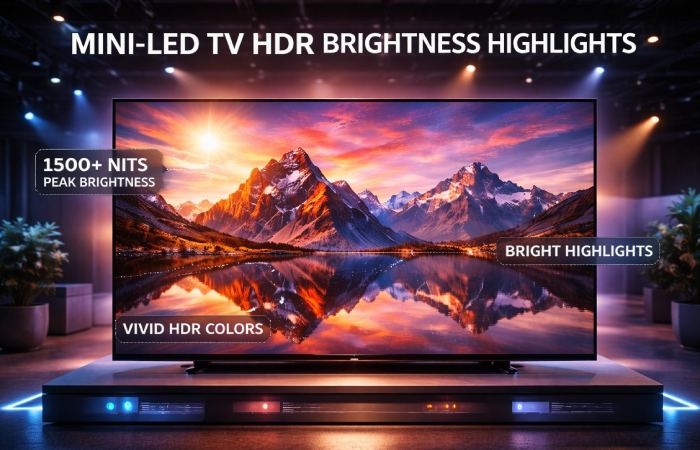
When evaluating CES announcements or making a purchase decision, these are the specifications that actually matter — and what they really mean in practice.
- Dimming zone count: More zones = more precise local dimming = less blooming. Under 500 zones: entry-level. 500–2,000: mid-range. 2,000–5,000: premium. 5,000+: flagship. Zone count alone does not determine picture quality — algorithm quality matters equally.
- Peak brightness (nits): For HDR impact, you want at least 1,000 nits. Premium Mini LED panels deliver 2,000–4,000 nits. The highest-end panels at CES 2024–2025 push 5,000+ nits. Higher brightness is more meaningful in bright rooms; in dark rooms, OLED’s contrast advantage becomes more relevant.
- Panel type: Most Mini LED TVs use VA (Vertical Alignment) panels for better contrast, or IPS/ADS panels for better viewing angles. VA with Mini LED backlighting is the most common premium combination. Some brands use their own panel variants (Samsung’s Quantum Matrix, TCL’s CSOT panels).
- Processor quality: The processor running local dimming algorithms, upscaling, and motion handling determines how well the panel’s hardware potential is realized. A 5,000-zone panel with poor dimming algorithms will look worse than a 2,000-zone panel with excellent ones.
- HDMI 2.1 ports: For gaming and future-proofing, confirm the TV has at least two full-bandwidth HDMI 2.1 ports supporting 4K/120Hz, VRR (Variable Refresh Rate), and ALLM (Auto Low Latency Mode).
- Panel size and price tier: Mini LED’s cost advantage over OLED grows with screen size. At 65 inches, premium Mini LED and OLED are comparable in price. At 75 inches and above, Mini LED offers significantly more value per inch.
Should You Buy a Mini LED TV Now or Wait for CES Announcements?
This is the practical question most buyers are actually asking. Here is a framework for thinking through the timing decision:
Buy Now If:
- You need a TV immediately — current-generation Mini LED TVs are genuinely excellent and competitive
- You find a strong deal on a previous-generation model — CES announcements typically trigger price drops on outgoing stock
- Your viewing environment is bright — current Mini LED brightness levels are already exceptional for lit-room viewing
- You are buying a very large screen (85 inches+) where Mini LED’s price advantage over OLED is already substantial
Wait If:
- CES is within 6–8 weeks — new model announcements will arrive and current prices may drop
- You are targeting a specific flagship model announced at CES — availability typically follows 3–5 months after announcement
- You are interested in emerging technologies previewed at CES (Micro LED, next-gen QD-OLED) that may be coming to market
- Your current TV is working fine — there is rarely a reason to rush a TV purchase
Frequently Asked Questions (FAQ)
The most common questions about Mini LED TVs and CES announcements.
What is Mini LED and how is it different from regular LED?
Mini LED uses thousands of tiny LEDs (around 0.1–0.2mm) as a backlight instead of the small number of larger LEDs used in standard LCD TVs. This enables far more dimming zones — meaning different areas of the screen can be brightened or dimmed more precisely. The result is significantly higher peak brightness, deeper blacks in dark scenes, and better HDR performance compared to standard LED LCD. It is not the same as OLED, which uses self-emitting pixels with no backlight.
Is Mini LED better than OLED?
Neither is universally better — they have different strengths. OLED delivers perfect blacks, infinite contrast, and better viewing angles, making it ideal for dark room, cinema-style viewing. Mini LED delivers higher peak brightness and better performance in ambient light, with no burn-in risk and lower prices at large screen sizes. For bright living rooms, sports watching, and large screens on a budget, Mini LED often wins. For dark room movie watching, OLED is still the gold standard.
Which Mini LED TV brand is the best?
It depends on your priority. Samsung Neo QLED is the strongest overall package with excellent processing and a mature ecosystem. TCL offers the best value — high zone counts and strong performance at significantly lower prices. Sony Bravia XR prioritizes processing quality and natural image accuracy over raw specifications. Hisense ULED provides competitive specs at aggressive prices. LG QNED sits in the mid-market with the benefit of LG’s webOS platform. For most buyers, TCL and Samsung represent the two ends of the value-vs-premium spectrum in Mini LED.
How many dimming zones do I need in a Mini LED TV?
For a noticeable improvement over standard LED LCD, aim for at least 500 dimming zones. For genuinely impressive HDR performance with minimal blooming, 1,000–2,000+ zones delivers a meaningful difference. Flagship panels with 5,000+ zones show further improvement but with diminishing returns for most content. Crucially, zone count alone is not the full picture — the quality of the local dimming algorithm matters as much as the number of zones.
When do CES-announced TVs become available to buy?
TVs announced at CES in January typically become available for purchase between March and June of the same year. Flagship models often launch first, with mid-range and value models following through summer. Pre-orders sometimes open within weeks of the CES announcement. Pricing announced at CES is usually the MSRP — actual street prices often drop within the first few months of availability.
Is Mini LED worth it over a standard 4K TV?
For most buyers watching HDR content in typical living room conditions, yes — a well-implemented Mini LED TV provides a noticeably better experience than a standard LED LCD at the same price point. The HDR pop, the brightness in highlights, and the improved contrast in mixed scenes are genuine improvements. For buyers watching mostly standard dynamic range (SDR) content, or viewing in very dark rooms where OLED would be preferred, the premium may not be as impactful.
Final Thoughts: Mini LED Is Now the Mainstream Premium Standard
What began as a premium technology curiosity at CES just a few years ago is now the defining mainstream standard for mid-range and above televisions. Every major manufacturer has committed to Mini LED at scale, prices have fallen dramatically, and the technology continues to improve rapidly year over year.
CES remains the single most important event for tracking where Mini LED is heading — both in terms of what you can buy today and what the technology will deliver in the next 12–24 months. If you are in the market for a television in the 65-inch and above category, Mini LED should be the starting point of your research.
The best approach: watch the CES announcements, wait for independent review measurements (not just press releases), compare the models that matter for your specific viewing environment and budget, and buy when the value is right — not just when the headline specification is impressive.
For more consumer tech insights, product guides, and marketing trends, visit World Marketing Tips at worldmarketingtips.com.