Marketing is a crucial component of business-to-business (B2B) companies because it boosts sales by helping you reach your target customers. In addition, promotional efforts can also raise brand awareness, which allows you to stand out from your competitors who sell similar offers. Furthermore, you can use this initiative to cultivate strong customer relationships, leading to repeat business and referrals to qualified leads.
However, most marketing campaigns will cost you a lot of money. Your business needs to spend on advertising and marketing campaigns so you can attract more prospects and increase sales. Aside from that, you won’t even know if your efforts generate the best results, so you might continue to waste funds on the same ineffective initiatives.
Fortunately, this article provides five tips for minimizing your B2B marketing costs without sacrificing excellent results.
Table of Contents
1. Targeting The Right Customers
You can spend lots of funds on marketing, but you’ll waste your efforts if you’re not targeting the right audience. Knowing what will work best for your business isn’t accessible if you have too many options. As a result, you will waste your time and financial resources on poor tactics that don’t bring in new customers or help you retain existing ones.
When targeting customers, you must look at your customer base or database and break them down into segments based on their demographic and psychographic profiles. Also, remember that you must distribute segments based on similar client characteristics, such as age group and business needs. After that, use B2B content syndication to identify prospects in purchase mode so you can save funds in chasing inactive and out-of-market buyers.
2. Finding The Most Effective Marketing Channels
The key to an effective marketing campaign is identifying the right audience and effectively communicating with them. The challenge is that when you’re not using the proper marketing channels, you might be discouraging audience engagement. So, you must know what your target customers frequently use to communicate with their favorite brands. Once you do so, you can introduce your offers to them.
For example, if you’re advertising on Facebook, but your target market is more likely to be on Instagram or Pinterest, then use those channels instead of Facebook ads alone. This strategy boosts brand reach to ensure more online users see your content. Also, you will avoid harming your reputation by showing up as irrelevant ads in front of people who aren’t interested in what you sell.
3. Repurpose Previous Content
Repurposing previous content is a great way to leverage your efforts, increase brand awareness and improve your search engine rankings. With this strategy, your customers will feel like you care about them more, knowing that you’re willing to go through the trouble of bringing back old content. In turn, you will build trust and loyalty between you and your customers, which is essential for ensuring the growth of your B2B company.
For instance, if you have an old blog post well received by your web visitors, you can turn it into a video or infographic. Next, you can take that content and publish it as a guest post on another site to reach a larger target audience without crafting other content. Thus, your marketing team can focus on promotional initiatives to encourage your clients to buy your products or services.
4. Recognize High-Performing Marketing Employees
Your top-performing employees need recognition for doing a job well. When you don’t recognize high performers to motivate them to continue performing well, they will likely leave soon after that. As a result, you need to hire new employees and repeatedly undergo the training process. Aside from that, you will miss out on those employees’ knowledge and experience when promoting your brand.
To keep costs in check, you must recognize the people producing excellent results. For example, you may send out an email thanking them for all they’ve done throughout the month and letting them know that you appreciate all their hard work. Alternatively, you may invite them to meetings with senior management to discuss how they contribute to the organization’s success.
5. Nurture Relationship With Customers
While it can be tempting to focus on acquiring new customers, nurturing your existing customer base is essential. This innovative marketing strategy includes activities after the initial sale to deepen the relationship between your organization and your clients. As a result, you will invite them to return to your store, which increases your revenue.
To nurture customer relationships, you should provide excellent customer service by offering incentives for repeat purchases. Next, you may build a sense of community among clients by sharing valuable information about how they can help each other. After that, you should also send personalized messages via email to receive more responses from them while making them feel special.
Key Takeaway
As a modern B2B owner, you must prioritize brand promotions without spending too much money and affecting results. Therefore, you should consider following these five strategies in reducing B2B marketing expenses. Once you do so, you can reach more customers, boost employee engagement, and create a positive brand image.
Cost-Saving Options: Print orders, in many cases, are now more specialist, high-end publications involving more creative differentiation as a result of digital replacing traditional media as the dominant format for mass consumption. For print customers, this can make things more difficult by expanding their options and possibly increasing their costs as well.
However, a beautiful print doesn’t have to be expensive. With a little knowledge and the right level of help from your magazine printing company, you may be able to find the simplest parts of your publication where prices can be cut. This will allow you to put money toward the parts that really make a difference.
The suggestions outlined in this article are meant to make you a more knowledgeable print buyer who is better equipped to deliver exceptional print work without hurting your profit margin.
What you’ll learn in this guide
Magazine printing costs in the UK depend on a handful of key decisions — quantity, page count, paper weight, printing method, binding, and finishes. Change any one of them smartly, and you can cut your cost per copy by 30–60% without touching the quality your readers see. This guide breaks down every lever, in plain English.
Table of Contents
Why Magazine Printing Costs Vary So Much in the UK
You can get quotes for ‘the same magazine’ from two UK printers and find prices that differ by 50% or more. That’s not one printer ripping you off — it’s because magazine printing costs are driven by several independent variables, and small changes to any one of them ripple across the entire bill.
Fixed setup costs spread across all copies — more copies = cheaper per unit
Very High
Page Count
More pages = more paper, ink, press time, and handling
High
Printing Method
Digital suits short runs; litho (offset) gets cheaper at 1,000+ copies
High
Paper Stock & GSM
Heavier, coated paper costs more — and increases postage weight
Medium
Binding Method
Saddle stitch is cheapest; perfect binding adds cost but gives a spine
Medium
Finishing & Extras
Lamination, spot UV, foiling — each adds cost; most are optional
Low–Medium
1. Print More Copies Per Run (or Combine Runs)
This is the most powerful cost lever in magazine printing — and the most misunderstood. Fixed setup costs remain the same regardless of quantity. Every magazine job requires artwork checks, press setup, calibration, and initial waste during make-ready. Those costs are spread across every copy you print. So the more copies in a single run, the cheaper each one becomes.
Print Run Size
Cost Per Copy (approx.)
Best Method
Verdict
1–50 copies
£3–£8+ per copy
Digital
High cost
100–250 copies
£1.50–£3 per copy
Digital
Moderate
500–1,000 copies
£0.70–£1.50 per copy
Digital or Litho
Good value
2,000–5,000 copies
£0.30–£0.80 per copy
Litho (offset)
Strong savings
10,000+ copies
£0.15–£0.40 per copy
Litho (offset)
Best unit cost
Note: Prices vary significantly by specification. Always request tailored quotes for your exact project.
Cost-Saving Tip: Batch Multiple Issues
If you publish quarterly, consider printing two or three issues at once during the same press run. Many UK printers will hold stock and dispatch in batches — this reduces your unit cost while avoiding large immediate storage needs.
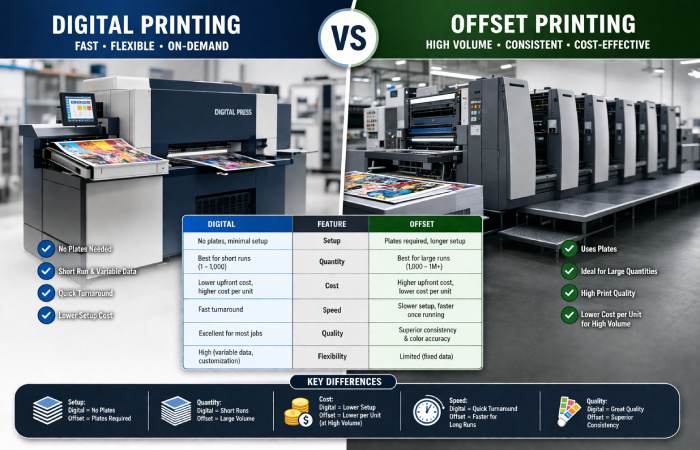
2. Choose the Right Printing Method: Digital vs. Litho
Digital printing suits short runs, while litho printing is more cost-efficient at scale.
UK magazine printers use two main production methods, and choosing the wrong one for your volume is one of the most common — and costliest — mistakes.
Digital printing is cost-effective for short runs, offers fast turnaround, and allows personalisation. Files go straight from your PDF to the press — no printing plates needed. Digital is ideal for runs under 500–1,000 copies, test prints, personalised editions, or when you need a fast turnaround.
Litho (Offset) Printing
Litho printing is better for high-volume printing, consistent colour, and premium finishes. Plates are made first (a setup cost), then ink is applied at high speed. The per-unit cost drops sharply as volume increases, making it the go-to for established publishers printing 1,000+ copies per run.
Factor
Digital Printing
Litho Printing
Best run size
Under 1,000 copies
1,000+ copies
Setup cost
Low / none
Higher (plates needed)
Cost per unit at volume
Stays relatively high
Drops significantly
Turnaround time
Fast (2–5 days typical)
Longer (5–15 days)
Personalisation
Yes (variable data)
Not practical
Colour consistency
Good
Excellent
Premium finishes
Limited
Full range
Which is right for you?
If you’re printing fewer than 500 copies, digital is almost always cheaper. Above 1,000 copies, get quotes for both and compare total cost — not just unit cost. Factor in turnaround time too, as faster digital delivery may save money on time-sensitive issues.
3. Optimise Your Page Count
More pages increase cost because each extra page requires additional paper, ink, and press time. A magazine with more pages uses more sheets, raising material costs. It also takes longer to print, fold, collate, and bind.
The key rule to know: magazine pages must always be in multiples of four. That’s because pages are printed on large sheets that are folded down. A 36-page magazine, for example, is not possible with saddle stitch — you’d need 32 or 40 pages.
Cost-Saving Tips for Page Count
• Audit every issue for content that can move online — a QR code linking to extra content can cut 8–12 pages per issue. • Tighten your design layouts to reduce page count. • Reduce full-page ads; use half-page formats for the same visual impact with fewer pages. • Always spec to a multiple of four — unnecessary extra pages are pure waste.
4. Choose Paper Wisely: GSM, Coating & Weight
Paper choice affects print quality, cost, and overall magazine feel.
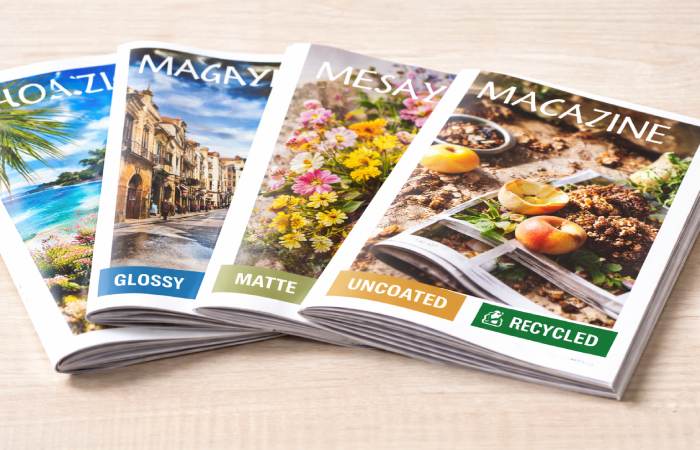
Paper is one of the biggest cost components in any print job — and it also affects postage, which can easily double your distribution cost if you’re mailing copies. A cost-effective, professional-looking magazine typically uses 80–100gsm silk for internal pages and a 200–250gsm silk cover.
Paper Type
Typical GSM
Best For
Cost Level
Offset / Uncoated
80–90gsm
Text-heavy, community pubs
Lowest
Silk / Satin
90–130gsm
Best all-round — sharp text + good images
Low–Mid
Gloss coated
90–150gsm
Photo-heavy, brand magazines
Mid
Premium heavyweight
150–170gsm+
Luxury / art publications
High
Watch Your Postage Costs
If you mail your magazine, paper weight directly affects your distribution cost. A switch from 130gsm to 100gsm internal pages can reduce copy weight enough to drop a Royal Mail pricing band — potentially saving hundreds of pounds per mailing. Always weigh a dummy copy before finalising your spec.
5. Pick the Right Binding Method
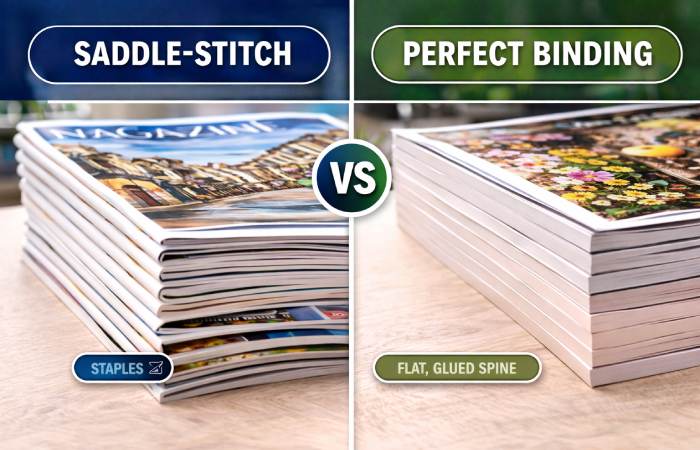
Saddle stitch is cost-effective, while perfect binding offers a premium finish.
Binding is one of the clearest places to save money — or waste it. There are two options that cover 90% of UK magazine projects.
Saddle Stitch (Staple Binding)
Saddle stitching is the least expensive of all binding methods. The printed pages are stapled through a fold and trimmed to size. It works best for magazines up to around 48–64 pages. Publications bound with saddle stitch can lay flat when opened, which is beneficial for many types of content. The main limitation: no printable spine area.
Perfect Binding
Perfect binding glues pages to a square spine — the format used for most paperback books. It gives your magazine a premium, shelf-worthy look and a printable spine. However, perfect binding costs more than saddle stitch — in design, materials, production, and often shipping.
Feature
Saddle Stitch
Perfect Binding
Page count range
8–64 pages
28–700+ pages
Cost
Lowest — best for budget
Higher
Printable spine?
No
Yes
Lies flat when open?
Yes
No
Production speed
Faster
Slower
Best for
Regular issues, newsletters
Annual / prestige editions
6. Skip (or Simplify) Expensive Finishing Options
Finishing options — lamination, spot UV varnish, embossing, foiling — can add 20–40% to your print bill. Here’s a quick guide to what’s worth it and what you can skip.
Finish
What It Does
Cost Impact
Worth It?
Gloss lamination (cover)
Shiny, vivid, protective coating
Low addition
Usually yes
Matt lamination (cover)
Subtle, sophisticated finish
Low addition
Usually yes
Spot UV varnish
Glossy highlights on specific areas
Moderate
Special editions only
Embossing / debossing
Raised or recessed design on cover
High addition
Luxury only
Foil stamping
Metallic finish on specific elements
High addition
Luxury only
Key Rule on Finishes
Cover lamination is almost always worth it — it protects the cover, enhances colour, and costs very little extra. Everything else (spot UV, embossing, foil) is for special or premium editions where the wow factor justifies the budget. A well-designed cover on matt-laminated 250gsm silk will look more premium than a mediocre design with expensive foiling.
7. Choose a Cost-Efficient Size
Magazine size directly affects how efficiently paper is used — and wasted. Standard paper sizes (A4, A5) are cut from standard sheet sizes with minimal waste. Custom or unusual dimensions often require oversized sheets that are trimmed down — you’re paying for paper you’re throwing away.
A4 (210 x 297mm) — The most common format. Best value for full-content magazines. Printers are fully set up for it, reducing setup time.
A5 (148 x 210mm) — Roughly half the paper cost of A4 for the same number of pages. Great for community newsletters, mini publications, or inserts.
Custom sizes — Can look distinctive but typically cost more due to paper waste and additional setup. Only worth it if the format is a core part of your brand identity.
8. Plan Ahead: Lead Time Saves Money
Faster turnaround may increase cost due to prioritised scheduling, production adjustments, or expedited logistics. Longer lead times generally help maintain standard pricing. If you can give a printer 10–15 working days instead of 3–5, you’ll typically pay standard rates rather than rush rates.
Set your distribution date first — work backwards from when readers need their copy.
Allow 10–15 working days for print production. More for litho runs; digital can be as fast as 2–5 days at standard rates.
Set your artwork deadline accordingly — add 3–5 days for proofing and corrections before submitting to press.
Book your print slot in advance — for busy periods (Christmas, trade show season), booking weeks ahead secures standard pricing and your slot.
9. Consider a Digital / Print Hybrid Model
One of the most effective cost-saving strategies for 2026 isn’t about printing at all — it’s about printing fewer copies more strategically.
Many UK publishers are moving to a hybrid model: a smaller print run for subscribers, premium readers, or display copies — paired with a free digital edition (PDF, Issuu, or web version) for general distribution. This lets you maintain the prestige and tactile experience of print while dramatically reducing your unit cost by printing at a more economical quantity.
Print 500 premium copies for subscribers and key distribution points.
Distribute a free digital edition via your email list or website.
Use digital analytics to understand which content is most popular — then invest that insight back into your print edition.
10. Consider Mono (Black & White) Interior Pages
If your magazine is predominantly text-based — think trade publications, community newsletters, literary magazines — a fully colour interior is not always necessary. Choosing mono (black and white) interior printing is perfect for text-heavy content and can significantly reduce per-page printing costs.
A common middle-ground approach: use full colour on the cover and the first few editorial pages (which readers see first), then switch to mono for text-heavy sections. This gives a professional impression while keeping interior page costs down.
One reprint due to an artwork error can cost more than all the savings you’ve made elsewhere. Here’s a quick checklist of what UK printers need from your files:
Save as a single multi-page PDF (saddle stitch) or separate cover and inner PDFs (perfect bound).
Use CMYK colour mode — not RGB. RGB files will be auto-converted, often with noticeable colour shifts.
Set image resolution to 300 DPI minimum for all photos and graphics.
Include a 3mm bleed on all edges.
Keep all important text and images at least 3–5mm inside the trim edge.
Embed all fonts in your PDF to avoid substitution issues.
Set black text as 100% K only — not rich black — for crisp, readable text.
12. Always Get Multiple Quotes — and Know What to Compare
UK magazine printing prices vary enormously between suppliers. Comparing quotations helps identify the most efficient option. But you need to compare like-for-like — a quote that looks 30% cheaper may exclude VAT, delivery, or use a lighter paper stock.
When requesting quotes, always specify:
Finished size (e.g., A4, A5, custom)
Total page count (including covers) — confirm it’s a multiple of four
Cover paper weight and coating (e.g., 250gsm silk, matt lamination)
Interior paper weight and type (e.g., 100gsm silk)
Binding method (saddle stitch or perfect bound)
Print quantity
Delivery requirements (address, timescale)
Whether the price includes or excludes VAT and delivery
Request Quantity Breaks
When getting quotes, always ask for pricing at two or three different quantities — e.g., 250, 500, and 1,000 copies. You might find that printing 500 copies costs only marginally more than 250, making the extra copies essentially free. This is common with litho printing where setup costs dominate.
UK Magazine Printers Worth Comparing
Here are well-regarded UK-based (and UK-serving) magazine printers to include in your quote process. Always verify current pricing directly with each supplier.
Printer
Best For
Notes
Mixam UK
Short–medium runs
Online instant quoting across a wide range of specs. Offers standard and expedited services.
HelloPrint UK
Competitive online pricing
Offers glossy, silk, and offset paper options. Well-suited for marketing-led magazines.
Ex Why Zed
Independent & arts publishers
Strong reputation among independent publishers. Good range of binding options with quality guidance.
Gemini Print Solutions
Trade & volume with fulfilment
Services include storage, packing, addressing, and delivery. Good for publishers who need fulfilment alongside printing.
YouLovePrint
Simple UK online ordering
Multiple binding options. Clear spec guidance. Good option for smaller independent publishers.
The Sustainable Printworks
Eco-conscious printing
No VAT or delivery charges. Monochrome printing option for text-heavy content. Specialises in community magazines.
Your Cost-Saving Checklist: Quick Wins at a Glance
Print the right quantity for your method. Under 500 copies: go digital. Over 1,000: get litho quotes.
Batch issues together if you publish quarterly or less frequently to reduce setup costs.
Keep page count to a multiple of four and audit every issue for removable content.
Choose silk 90–100gsm for interior pages — the sweet spot of quality and cost.
Use saddle stitch for issues under 64 pages. Only use perfect binding when your content demands it.
Cover lamination yes; spot UV, foil, and embossing only for special editions.
Stick to A4 or A5. Custom sizes cost more due to paper waste.
Give printers 10–15 working days at standard rates whenever possible.
Get quotes from at least three UK printers using the same full spec.
Consider a hybrid model — smaller premium print run plus free digital edition.
Consider mono interior pages for text-heavy publications.
Frequently Asked Questions
How much does it cost to print a magazine in the UK?
It depends heavily on your specification, but as a rough guide: a 32-page A4 magazine on silk paper with saddle stitch binding might cost £0.80–£1.50 per copy for 500 copies with digital printing, or around £0.40–£0.70 per copy at 2,000+ copies with litho. Always request tailored quotes for your exact spec.
Is VAT charged on magazine printing in the UK?
Many printed publications — including magazines, newspapers, and books — are zero-rated for VAT in the UK. However, this depends on the specific nature of the product. Promotional publications that are primarily advertising may be subject to standard rate VAT. Always confirm the VAT position with your printer and HMRC guidance.
What is the minimum quantity for magazine printing in the UK?
Some UK printers will print as few as 100 copies in a single run. For digital print-on-demand, some suppliers will print single copies. The trade-off is always cost per unit: small runs cost significantly more per copy.
What’s the most cost-effective paper for a UK magazine?
For most UK magazines, 90–100gsm silk for interior pages and 200–250gsm silk with matt lamination for the cover is the sweet spot. It looks highly professional, photographs reproduce well, and the cost is lower than heavier-weight stocks.
Can I reduce printing costs by using black and white interior pages?
Yes — significantly. Mono (black and white) interior pages cost considerably less per page than full colour. If your magazine is text-led — a trade publication, community newsletter, or literary journal — mono pages with a colour cover is a very cost-effective combination.
Should I use a local printer or an online UK printer?
Both have merits. Local printers offer easier communication, the ability to see samples in person, and potentially faster turnaround for urgent jobs. Online UK printers typically offer lower prices through automated processes and volume discounts. For your first run with any new printer, getting a physical proof first is always recommended.
Final Thoughts
Cutting magazine printing costs in the UK doesn’t mean settling for something that looks cheap. It means making smart decisions about the variables that affect your bill — and knowing which ones deliver genuine savings versus false economies.
Start with quantity and method (the biggest levers), then work through paper, binding, and finishes. Build lead time into your production calendar. Get multiple quotes using a precise, consistent specification. And always proof before you print.
Do all of that, and there’s no reason you can’t produce a magazine that looks every bit as good as a newsstand title — for a fraction of what you’d naively spend.
Disclaimer: Prices quoted in this article are approximate guides only and subject to change. Always request up-to-date quotes directly from printing suppliers for your specific project. This article does not constitute professional printing or financial advice.
In the realm of digital marketing, you’ve probably heard that content is king. But in terms of content, video is considered the most effective type. This makes video the king of digital marketing.
As a powerful asset, businesses of all sizes should be using video to its fullest potential. If you need the facts, then here are some of the biggest reasons why video should be unequivocally used in your overall marketing strategy.
Table of Contents
1. Video Commands Attention
In a busy digital world, so many things are fighting for a consumer’s attention. And there’s only so much attention to go around. Being able to capture a user’s attention in just seconds can be difficult. However, an effective video can help you do just that.
Since video uses both aural and visual stimuli, it’s far better than static advertisements in capturing a user’s attention. While a user may stop to look at creative photos, videos are known to hold attention up to 5x more than still photos.
That said, the first few seconds of your video should be creative and compelling enough to make a user stop scrolling and focus on your content. In this case, you want to hire an expert video agency like Rockmans Creative Media to create high-end business video content that instantly attracts attention.
2. Video Can Explain Things Better
If a picture is worth a thousand words, how much more does a video convey?
A video can provide more information than text or photos when launching a new product or service. By showing users how your services or product works, they’re more likely to have a better understanding of the products or services. You can even add subtitles to the video to help make it easier to understand.
In addition, if you’re trying to explain difficult concepts, videos can make it easier. For instance, creating animated videos can bring these difficult concepts to life that no live video or text can. Animated videos are the perfect combination of simplicity and entertainment. Plus, they work.
3. Video Improves Leads, Conversions, And Sales
Video can significantly improve your business’s revenue and bottom line. Video is a brilliant investment that helps in generating leads. Over 80% of marketers revealed that they have experienced increased leads when they’ve included videos in their marketing strategy.
Furthermore, simply adding a product or service video on your website’s homepage or landing page can boost conversions by up to 80%. Over 80% of marketers also said that video positively influences sales. Since videos can increase users’ understanding of their services or product, it impacts their buying decision. A report shows that more than 70% of people who watched an explainer video subsequently bought the product or service.
4. Google Loves Videos
YouTube is one of the most popular platforms on the web that primarily caters to video content. But what’s best is that Google owns YouTube. This is extremely beneficial for digital marketers in improving their SEO rankings.
In general, a key part of every digital marketing strategy is optimizing search engines, primarily Google. Since Google owns YouTube, there’s a significant increase in how much videos impact your search engine ranking. Google prioritizes ranking pages with video, especially one from its website, for a myriad of keywords. This means that pages with videos are more than 50x more likely to rank in the top results than those without one.
Plus, videos tend to go viral, racking up staggering amounts of backlinks, traffic, and other SEO-related requirements with way less effort than tactics such as guest posting.
5. Videos Are Shareable
Highly shareable on different platforms, videos consistently outperform other content, particularly text-based posts, on social media platforms. A report shows that video is up to 40x more likely to be shared on social platforms than other content. This is because the average human processes visuals faster than text.
Besides, social media also encourages video content with features like live video, stories, and reels. This provides you with more opportunities to showcase your brand and engage your customers. In addition, followers who share your videos on their profiles can significantly boost your marketing efforts, introducing you to new potential customers and ultimately increasing brand awareness. Plus, when users share your videos, it signals to others that you’re a reliable and trustworthy brand.
Take Away
All this says one thing– video is the present and the future of the digital marketing space. So, if you’re not yet using video marketing, you need to start immediately. Video marketing is one of the most effective ways to reach your target audience in this digital area and provides the most impact on your viewers, ultimately helping your bottom line.
Google plays a vital role in local businesses reaching out to the target market. It is easier now to look for products and services with one click. This looks like an opportunity for new companies to level up their ways to expand the business. It is as important as setting a budget for SEO services to get started in enjoying more of their benefits.
Not adapting to SEO will make you lose potential customers. However, beating the competitors urges you to be extra relevant to withstand the local search. People are now conscious of what they are going to buy, even though it is done online.
Table of Contents
Describe Local SEO
Local SEO is made for small businesses who are wishing for more traffic on search engines. This tool helps to improve brand visibility online which is extremely possible nowadays.
Perhaps a potential buyer is looking for products and services similar to what your business offers. Consequently, local SEO will get you in the best position so that prospects will find your business easily.
It works with search engines to build a good reputation for a certain business. Beforehand, ensure whether the firm is SEO-optimized to appear in local results.
An Ultimate Guide For Local SEO
Here is a list of tips you can consider in using SEO for local businesses:
1. Take Advantage of Google Tools
One is Google My Business which works to boost your business on local searches. When a local entity is Google-optimized, it will be easier to infiltrate the local search and reach out to potential shoppers.
Also, customers who share reviews are a cost-efficient way to boost your brand.
2. Use Social Media
Connect your business to social media platforms and engage with the audiences. Make sure to include clickable sites to bring customers to your official website.
Use internal links reliable to the business. There are SEO tools you can depend on to help boost your ranking.
3. Set Up Available Contacts
It is useless to appear online with an inaccessible phone number and address. Search engines will require a constant online presence to keep you on top. So, make it easier for potential customers to find your business.
The citation must also be clear and consistent, meaning you should avoid missing words and numbers. Google may get in trouble locating your business with the wrong listings.
Set a location that is easy to navigate using Google Maps.
4. Execute Regular Audits
Managing a business online takes continuous work to fulfill goals. Inspect for possible errors and inaccuracies that could affect the search ranking. Double-check the links and other citations to ensure the website is functioning well.
This can tell if making changes is necessary for the business.
5. Improve Content Quality
A quality blog post contains a meta description, headers, and URLs which are vital for beating search engines. Writing content must also include keywords that may easily appear in local searches.
Focus on local audiences in writing blog posts. This strategy will help you persuade the target market a lot easier.
Adding inbound links will boost your domain authority using local SEO. It will extend your network with the right local manufacturers to partner with.
6. Be Mobile-Friendly
Buying stuff online has become the new norm in the past year. Accordingly, making use of mobile phones to search for products is susceptible for most shoppers.
Building a mobile-friendly website is a logical step to cater to the target audiences. It is also easier to gain prospects via phone which will lead to sales.
7. Build Local Community
Lastly, brand awareness will happen quickly with the help of the community. Start to engage with organizations that will benefit your business. It will increase your search scope within the region.
Why Invest in SEO Tools?
Local SEO has to offer different tools to meet every business need. They all have a single purpose which is to boost your search engine ranking.
These are practical tools to keep your business well-off. It is then easier to compete with other companies to showcase products and services via digital sources. As evidence, almost 50% of consumers browse local searches to buy items.
Here are other benefits of SEO for local businesses:
SEO Guarantees Data Accuracy
SEO listings are verified by Google to promote trust in online searches. Adding proper citations will also bring your business to the top of the search engine ranking.
SEO Can Boost Visibility
SEO includes backlinking with the use of keyword research as an anchor text containing a link to your website. Once a potential client clicks the link, there are chances of converting traffic.
SEO Attracts More Investors
Building relationships with other local companies is possible with SEO. This is necessary to quickly grow a business with minimal effort in the long run.
SEO Helps Generate Feedback
Once people find out about your business via local searches, they have no choice but to leave a comment. It could be a marketing strategy to reach out to more clients.
Conclusion
To summarize, local SEO must be reliable to what your business offers. It contributes a lot to online businesses in terms of creating quality content with a higher rank in the search engine. Follow the above tips to obtain the full benefits of SEO for any local enterprise.
Have you ever wondered where a popular meme originated? Everyone on social media knows memes and there are plenty to go around.
Do you know why people make memes? Why are they popular? Or what is the history of memes?
Explore the stories behind your favorite memes with us in this article. Keep reading!
Table of Contents
The History of Memes
A meme is an image, video, or piece of text that is copied and spread by Internet users. Richard Dawkins was the one who coined the name meme in his 1976 book The Selfish Gene.
Dawkins described memes as a “unit of cultural transmission” that you can forward from one individual to another.
The first major wave of memes began in the early 2000s with the advent of social media platforms like Myspace and YouTube. These platforms allowed users to easily share images and videos, which led to the spread of popular memes like “Lolcats” and “Rickrolling.”
How Memes Have Evolved Over Time
Memes are ideas, behaviors, or styles that spread from person to person within a culture. A meme carries cultural ideas, symbols, or practices, which you can forward from one mind to another through writing, speech, gestures, rituals, or other imitable phenomena.
Over time, memes have evolved to become an integral part of our online culture. They are often used to convey humorous or insightful messages and can be an effective way to communicate with others.
The Most Popular Memes Throughout History
The most popular memes typically start as inside jokes among a group of people and then spread to the wider internet.
The first known meme was the “Dancing Baby” animation, which went viral in the early days of the internet. Since then, there have been hundreds of popular memes, ranging from the “Gangnam Style” dance to the ” Distracted Boyfriend” meme.
While some memes are simply entertaining, others can be more meaningful. In recent years, memes have been used as a way to spread awareness about important social and political issues.
For example, the “Me Too” movement against sexual harassment and assault gained traction in part because of the widespread sharing of the “Me Too” meme.
Impact of Memes on Society
Since their inception, memes have been an integral part of online culture. They are often used to convey a message or share a joke and are often Leo-related. While some memes are harmless fun, others can have a more serious purpose.
In recent years, memes have been used as a tool for political commentary and social activism. Memes have also been known to start internet-based debates and movements.
With their ability to reach a large audience quickly, memes have the potential to impact society in a positive or negative way.
Creating Your Own Meme
If you want to create a successful meme, you need to have a good understanding of what makes a meme successful in the first place.
Some factors that can affect a meme’s success include its overall quality, how relatable it is, how easy it is to understand, and how funny it is. Even a restaurant logo design can become a successful meme!
Enjoy Memes Today
They are often funny, relatable, and make us think. The history of memes has evolved over the years and will continue to do so. They are a reflection of our society and our values.
Keep up with the latest memes and share them with your friends!
Did you find this article helpful? Check out the rest of our blogs!
The bygone year, 2021, was a turbulent year for the crypto market. It has been a testimony to a sea of changes sending investors into fits of frenzy while trying to leverage the assets. As a result, Bitcoin and Ethereum have hit an all-time low. While there have been surges recently, the field of the crypto market is stalled. While it is not certain, experts say that prices can fall even further before experiencing sustained recovery.
Bitcoin has hit several all-time new prices in 2021, followed by big drops. Ethereum, the second-biggest cryptocurrency, notched an all-time high late last year. An executive finance online course can help you understand the different digital currencies and their trends.
However, the industry is only in its infancy and continually evolving. Today, it is still a buzz among cryptocurrency enthusiasts who are busy discussing its future trends. As a result, it is quite challenging to predict where things are headed; however, with a few predictions being made, the future of crypto is quite specific.
Table of Contents
Let us discuss the top future trends of cryptocurrency.
1. Cryptocurrency regulation:
Lawmakers are trying hard to lay down laws and guidelines that safeguard cryptocurrency for investors while making it less appealing to cyber criminals. Even after experiencing the tragedy of the pandemic, we have still witnessed a rapid acceleration in the move from a physical economy to a digital one. There has furthermore been a significant decline in the use of cash. Today, both real economy and financial markets promise to digitalise further and are primarily driven by a combination of public policy, new technologies, and entrepreneurial zeal. It does not promise the success of all innovators – only a few can succeed. Maintaining an optimum balance between innovation and stability can be quite challenging.
2. Global transformation:
The world has witnessed a rapid acceleration with the transformation from a physical economy to a digital one. Likewise, financial services have witnessed a seismic shift with a marked decline in the use of cash. The economy and financial market are digitising rapidly and are primarily driven by a blend of entrepreneurial passion, new technologies, and public policy. An executive finance course will help you to acquire knowledge of the financial key terms and their offerings.
3. The oncoming of web 3.0:
This is one of the most profound changes that digital currency is bringing. It will allow smart contracts to automate transactions while integrating them into one’s daily life. The transparency of the blockchain moreover grants users access to the internet in a significant manner, as witnessed today. Peer-to-peer exchange of content tends to vary with content gatherers. Moreover, an online executive finance course can help you gather the necessary knowledge about digital currencies to predict future outcomes.
4. Rise of metaverse:
This is a common term we keep hearing about; however, sometimes, we fail to materialise it. The storm of cryptocurrency, virtual reality, social media presence, NFTs, and interactive content propagates immersive worlds that are well accessed online. Whether it is good or bad for human society is still debatable; however, it is not important to discuss that right now. Instead, several online finance courses give you a thorough idea about digital currencies and their offerings.
5. The boom in the DeFi space:
As per DeFi Pulse, the total value locked (TVL) is a measure of the total value of cryptocurrencies committed to a smart DeFi contract. This grew from around $2 billion to $15 billion in the year 2020. The last year witnessed a booming growth of TVL that ended at just $100 billion, with yield farming being one of the most popular DeFi applications. It involves lending the crypto assets to various other platforms offered in return for new cryptocurrencies. There is a significant difference between digital banking and yield farming. The users deposit the crypto assets and receive interest on the assets.
The depositor, in most cases, tends to stake new crypto platforms. They will further receive the new crypto asset in exchange for the liquidity offered. Yield farming platforms have attained notable attention, thanks to the higher rates offered to depositors.
6. An abundance of private currencies:
With a tapestry of currencies flooding the world, there is an abundance of private currencies, with most being quasi-fiat and private, and some occupying the middle position. There will be physical representations, especially of sovereign currencies, primarily digital in form. Although not all are widely accepted payment instruments, cryptocurrencies continue to bloom, some might become institutionalised investment assets. Physical cash will continue to exist in the future, even when there is a decline in usage. Enrol in an executive finance program and know more about different private currencies.
7. Central bank digital currencies:
Several national banks today have decided to explore the multiple possibilities that digital currencies offer. They have already created several versions of the currencies known as Central Bank Digital Currencies (CBDs). Being present on powerful crypto trading platforms, CBDCs are primarily useful for them. With increased crypto trading platforms, CBDCs will soon rise in importance, becoming one of the most significant trading assets in the crypto market. Join the Executive Programme to learn more about how digital currencies help individuals.
8. Expansion of market of DApps:
Decentralised Applications (or DApps) are referred to as software applications running on distributed peer-to-peer networks. There is a massive potential for DApps to prosper in the present market, with DAppRadar estimating the volume increase to $271, from $21 billion. Most of these apps run on the Ethereum blockchain while serving a few functionalities of DeFi. As many as 45% of the apps run on the Ethereum blockchain. Platforms such as TRON and EOS are also gaining a good amount of traction. Moreover, EOS addresses several problems with creating DApps on the Ethereum blockchain. For example, a finance program can be largely helpful in understanding the basics of decentralised applications.
9. Cross-border currency competition:
There can also be intensified competition between public and private payment instruments across national boundaries. Hence, there will be rising competition between currency areas and nation-states. Whether it will be waged by a central bank or private sector proxies needs to be analysed. The competitive arena will extend to regulation, technology, and governance with a universal agreement regarding the benefits of interoperability and cooperation about who can attain the more competitive edge.
The future might witness the coming together of regulators on a global framework welcoming crypto regulation. We can closely speculate the value cryptocurrency might have for investors in the oncoming years. However, the reality is it still being a new and speculative investment without much history. No matter what an expert says, no one really can be certain about it. Therefore, it is crucial to stick to more conventional investments giving birth to long-term wealth accumulation. An executive finance online course might be beneficial in teaching finance about digital currencies and their potential offering in the present and future.
You can’t run a successful business without a loyal consumer base. Establishing strong customer relationships is one of the core strategies behind solidifying your brand and boosting sales. However, onboarding clients can be challenging, especially when starting out in the competitive corporate sector.
Through this marketing process, you can generate leads and expand your company by targeting a specific audience. Statistics show that lead generation advertising spending is expected to reach $3.2 billion by 2023 in the U.S. alone. How can you create a plan to make the most of your marketing content? Keep reading as we explain what lead generation involves, different lead types, and some tips to implement it effectively.
Table of Contents
What Is Lead Generation?
Lead generation is the act of inducing and capturing an individual’s attention towards your product or service to increase your clientele and revenue ultimately. Lead generation incorporates mediums like digital and social channels to promote a brand and bring in interested consumers.
Types of Lead
Now that you know what lead generation is, let’s look at some different kinds of leads so you can determine which one would align seamlessly with your marketing strategies and resources.
1. Sales Qualified Lead (SQL)
SQLs are leads that indicate they are interested in purchasing your product or service through their actions. For example, a person who fills out a form or sends an email to attain information that’ll enable them to take the next step and become a paying customer. SQLs are prospects ready to contact your sales team, but they could still be comparing what you offer with your competitors. They’re considered very hot leads, and you should pursue them without delay to avoid losing their favor.
2. Service Qualified Lead
These leads are customers or prospects who’ve already reached out to your service team and let them know that they would like to be a client. Suppose you inform a streaming service representative that you wish to upgrade your subscription. In this case, you are a service-qualified lead, and the representative will direct your request to the appropriate sales team member.
3. Marketing Qualified Lead (MQL)
MQLs actively search for solutions that are helpful to them. You can identify them by paying attention to their activity on your website or digital content, for instance, downloading case studies, attending webinars, or watching videos on how your products or services work. Since they’re focused on learning about your brand, you need to nudge them in the right direction and convert them into prospects.
Send them an email or have an enlightening conversation. If you think the MQLs are ready, you can present them with a demo or deliver a presentation. However, remember that not all of them will use your solutions, so remain persistent and keep following up with emails.
4. Product Qualified Lead (PQL)
Product qualified leads are prospects who use your products and have a good experience with the solutions, pushing them to indicate that they are considering becoming a regular customer. And also they are usually generated when companies supply free, limited product versions or a product trial period.
If people like the samples, they are offered upgrade options, and this is when the sales team sweeps in to attempt client conversions.
A customer who tries your test piece and proceeds to ask about features that can only be used upon payment is an example of a PQL.
Lead Generation Strategies
In this section, we’ll provide some tips on effectively practicing lead generation.
1. Live Chat Engagement
Most individuals don’t make a purchase blindly. They’ll visit your website and look for a section where they can place their queries. Live chat is not only effective for generating leads, but it also makes connecting with your website’s visitors simple and easy. You can answer a prospect’s questions immediately in a live chat session and capture their interest in your business.
Having chatbots for your website will automatically collect leads, triggering a chat widget to emerge at the right time and asking visitors whether they’d wish for additional information. You can utilize a seller-centric platform and automation workflows to simultaneously assign potential clients to salespeople for follow-ups, collect contact data, and send a welcoming email.
2. Multimedia Content
Technological advancements and changing trends have shifted online interactions from text to other media, such as podcasts and video content. In today’s world, videos are significantly popular, attracting various audiences and nurturing existing customers. According to Forbes, adding a video to marketing emails boosts click-through rates by around 200% to 300%. Videos are a great way of increasing website traffic and profits.
You can create long-form videos offering specialized advice to prospects. Also, With the help of lead generation tools, they can be cut into short teasers that appear in YouTube videos with links that direct viewers to your website for the full version.
3. Create Referrals Programs
There’s no better way to generate high-value leads than through customers who love your products or services. Also they’re well-versed with your brand, they’re much more likely to recommend it within their network, especially to people who could benefit from your business. However, it would help if you didn’t wait for them to do the work for you. Create a referral program that makes it rewarding and straightforward for them to relay information regarding your products to their family, friends, and coworkers.
Through such a program, you can encourage loyal customers to provide referrals using click-to-share links or well-timed asks, receiving discounts for every new customer they help refer or secure. Referrals can bring in top-notch leads, and most marketers claim that setting up these programs has a lower cost-per-lead compared to other marketing techniques.
4. Newsletter
Nobody wants to be spammed by email or on the phone. You’re likely to scare prospects away by badgering them with information every day. Instead, show that you remember them and are around using a newsletter. Remind them of your products and services through a physical or digital copy. Don’t hesitate to pinpoint deals that are tailored to meet their needs.
Endnote
Gone are the days of people appreciating random cold calls. The internet has led to evolved ad mindful thinking, where individuals are well-informed regarding what products and services they want to consume. As an entrepreneur, you must know that managing a business is no easy feat- you should always be ready for change. The lead generation process is critical to securing buyers and increasing conversion rates. Without it, your business growth will suffer, and you’ll struggle to attract customers and opportunities.
Nelle piattaforme che permettono di giocare al bingo online in modalità streaming il caller è una persona in carne ed ossa. I siti di bingo online sicuri sono quelli con concessione ADM, quelli e basta. Qui sotto vogliamo darti una lista di alcuni siti virtuali di Tombola sprovvisti della licenza ADM e quindi del tutto illegali e per nulla sicuri. Leggi questo elenco con attenzione e non iscriverti mai in nessuno di questi. Quando si parla di bingo online si fa riferimento alla versione statunitense della famosissima tombola. Rispetto a quest’ultima, il bingo si distingue per una maggiore semplificazione del meccanismo di gioco.
Bingo con jackpot
Controllate poi sempre che il bonus di benvenuto bingo valga anche per le partite etichettate come tombola. Le sale di tombola online oggi propongono una versione riveduta e corretta del tradizionale gioco italiano. Di fatto, si distinguono dal bingo nel layout del gioco e delle cartelle, ma soprattutto per la presenza di premi intermedi quali ambo, terna e quaterna. Se amate cambiare gioco, con le numerose varianti di bingo non avrete che l’imbarazzo della scelta. Analogamente alle mille opzioni fornite dai migliori siti Gratta e Vinci online, con il bingo troverete un’ampia offerta di giochi ad alto tasso di adrenalina. AdmiralBet Bingo compone il suo bonus di benvenuto con un bonus sul deposito del 50% fino a 100€ sulla prima ricarica.
Come Vincere al Bingo Online
Ad ogni nuova partita, i numeri vengono generati in modo casuale, garantendo un’esperienza unica e imprevedibile ogni volta. Se nella tombola ricercate soprattutto la convivialità delle classiche partite d’altri tempi, il gioco online che più si avvicina a ricrearne l’atmosfera è a mio avviso il bingo live. Sfruttandolo riuscirete ad avere una somma ulteriore da utilizzare nella vostra sala preferita. Quello classico, che va a chi marca per primo tutti i numeri di una delle cartelle, equivale a circa la metà dell’incasso della sala. In aggiunta, può esserci il “bingo one” ottenibile entro l’estrazione del 46° numero. Il “bingo one extra”, invece, raddoppia il valore del “bingo one” se si arriva al “bingo” tra il 46° e il 47° numero estratto durante la sessione del “bingo one”.
I giochi principali del Bingo di Giocodigitale.it
Queste due principali declinazioni rappresentano i pilastri su cui si sono poi innestate numerose altre interpretazioni. A queste si aggiungono infatti ulteriori versioni come il Bingo a 30 o 80 numeri, che movimentano il panorama con partite più scattanti e un ritmo più serrato. Alcune sale, sia fisiche che virtuali, arricchiscono l’offerta con varianti a tema o con allettanti jackpot progressivi, rendendo l’esperienza ancora più stuzzicante e potenzialmente generosa.
Vi stiamo guidando attraverso le diverse opzioni, aiutandovi a scegliere i programmi che meglio si adattano al vostro stile di gioco e alle vostre preferenze. Da quelle classiche a quelle più moderne, ogni variante è analizzata per garantire che i giocatori possano trovare il gioco che più si adatta ai loro gusti. La diversità è un valore aggiunto che teniamo in grande considerazione nella nostra selezione. Accettiamo solo quei siti che offrono una vasta gamma di metodi di pagamento verificati, compresi quelli che garantiscono transazioni immediate e protette. Questo è un pilastro della nostra valutazione, per la vostra serenità finanziaria. Successivamente, si passa all’estrazione… non dei denti per carità, ma dei numeri!
La ricchezza dell’offerta ludica è un fattore decisivo nella scelta dei siti bingo online. Ci impegniamo a selezionare piattaforme che presentano un’ampia scelta di giochi, assicurando così un’esperienza di gioco del bingo snai app online variegata e di qualità. Dopo aver consultato la tabella, noterete che ogni operatore ha qualcosa di unico da offrire.