Investment property loans are becoming more and more popular, especially among those who are looking to take their finances to the next level. With a loan for an investment property, you can secure the funds you need to make your purchase and get started on turning your dream property into a reality. Here are a few tips to help you get the loan you need.
Table of Contents
Determine Your Needs
Before you even start the application process for your investment property loan, it’s important to have an idea of what you’re searching for. Do you need funds to cover the entire purchase price? Is there a specific property you’re interested in? Once you have an idea of what you need, it’ll be much easier to narrow down your options and find a lender who can help you reach your goals.
Types Of Loans Depending On Property
A loan for an office building may have different stipulations than a loan for a house. This is because the risks and rewards of investing in an office property are different than investing in a residential property.
Therefore, you will need to determine your needs and find the right loan for your investment property. There are several types of loans available, including:
-Development loan: This type of loan is used to finance the acquisition, construction, renovation or conversion of an office or commercial building.
-Refinancing: If you’re already signed up for a mortgage on your home and want to use the extra money to invest in real estate, refinancing may be a good option for you. This means that you’ll be borrowing money from the bank rather than getting a new loan altogether.
-Conversion: If you already own an investment property but would like to make some changes, such as adding on new rooms or converting it into an apartment complex, a conversion loan might be ideal for you.
Be Flexible With Your Timeline
Don’t put too much pressure on yourself when it comes to getting approved for a loan. There are many factors that go into lending decisions – not all applicants will be approved regardless of how qualified they may seem. Be patient – it can take several weeks or even months before lenders make their final decisions about applications.
Be Sure To Follow Up With Lenders
Don’t forget to follow up with lenders periodically – especially if there have been any changes in your life that could impact your ability to repay the debt on time.
Research Loan Options
Once you’ve determined your needs, it’s time to start looking for a loan. There are a variety of loan options available, from fixed-rate loans to those that offer adjustable rate options. It’s important to choose the right option for you and your financial situation.
Make a Pre-Qualification Form
Once you’ve selected a loan option and have determined your eligibility, it’s time to make a pre-qualification form. This document will help your lender determine if you’re a good fit for their loan and whether you’re ready to commit to a purchase.
Get Prequalified For A Loan
Before you even start the application process, it’s important to get prequalified for a loan. This means that your lender will evaluate your credit score, debt load, and other financial information in order to determine if you’re likely to repay the loan on time and in full.
Once you have been prequalified for a loan, it’s time to start looking for an investment property lender who can help you reach your goals.
Begin The Loan Application Process
If you are interested in obtaining an investment property loan, you will need to complete a loan application. Start by gathering all of the information that you need to complete your loan application. This includes your current financial situation, the property that you are interested in purchasing, and any documentation that is necessary to support your application.
Once you have been pre-approved, gather all of the documentation needed for your loan application. This includes copies of your current financial statements and tax returns, as well as any supporting documentation such as leases or deeds to the property that you are interested in purchasing.
Complete the online loan application form by providing all of the required information and documents. Once completed, submit the form to the lender via email or fax for review and approval.
Get Approved for a Loan
After you’ve submitted your pre-qualification/application form, it’s time to wait for a response. Depending on the lender you’re working with, this process could take a few days or weeks. Once you receive a response, it’s time to go back through the process and finalize the details of your loan.
What Do Lenders Look For In A Good Applicant?
There are a few key factors that lenders look for when considering an investment property loan. With a loan for an investment property, you can finally make your dream come true.
One of the most important factors is the borrower’s credit score. Lenders want to make sure that the applicant has a solid track record of paying their debts on time, and that they have enough equity in their property to cover any potential debt obligations.
Another key factor is the borrower’s ability to commit to maintaining the property. Lenders want to make sure that applicants have a long-term plan for keeping the property up and running, and aren’t just looking to flip it as soon as they can get a higher sale price.
Lastly, lenders look for reliable documentation of any investment properties that applicants own. This includes not only financial statements but also recent tax returns and land title records if applicable.
Once you have all the information your lender needs, it’s time to start the purchase process. Make sure to have enough money saved up so you don’t have to get a loan in multiple parts, and be prepared to go through some hoops to get your purchase approved.
The process may seem difficult, but once you lay everything out on the table, it will be much easier to get a loan approved.
When it comes to hiring employees for your company, you want to make sure that you’re hiring the best talent. Hiring the most qualified employees means that your business will be more successful, so you’ll want to make sure that the best of the best will apply to your company. Attracting employees is similar to attracting customers (or clients, if you provide services instead of selling products). You want the most qualified people to work for your company, rather than your competitors or a similar company.
Here are four ways that you can get the most qualified job seekers to apply to your company.
Table of Contents
#1: Fine-Tune Your Brand Identity
One of the first things you must do to capture the attention of job seekers (and customers/clients) is to create a strong brand identity. The brand identity of a company is composed of what is seen and what is unseen. This means that your brand identity will consist of your company name, logo, color scheme, and motto— but it should also tell a story at the same time. This brand story should include why you started your company, what your values are, and what you hope your company will accomplish in the lives of your customers/clients.
When job seekers can resonate and identify with your brand identity, then there’s a better chance that they’ll be a good fit for your company. This identity is the face of your business and it builds credibility. It also creates trust with both potential employees and customers/clients.
#2: State Why Each of Your Job Positions Matter
Any company can write up a detailed job description, but what is the bigger purpose of the job position you’re hiring for? Does this position require creatives, innovators, and/or thinkers? The goal here is to let them know that their natural skills and abilities are critical to the success of your business.
It’s also a good idea to let your prospects know that the job presents a challenge. Not only does this weed out those who are looking for an easy job, but it also lets top talent know that they can make an impact— if they’re up for the challenge. When employees feel like they’re being challenged, they know they’re putting in more work and that what they do matters to the company.
#3: Establish Your Company’s Work Culture
Whether employees are aware of it or not, all workplaces have a “work culture”. Work culture refers to the behaviors, beliefs, and attitudes that make up the environment of a workplace. It evolves from everyone within the company, from management to entry-level employees. Management sets the tone for the work culture and employees to follow, so make sure that you know exactly what you want your work culture to be.
Amenities and other office items can help set a tone for your work culture as well. For example, a coffee maker can symbolize you and your employees fueling yourselves with energy to get all of your work tasks done. Or maybe you could use herbal tea instead, symbolizing a more relaxed environment.
#4: Create a Career Site on Your Website
What better way to showcase how great it would be to work for your company than on your website— and yes, your business should have a website. Career sites are a way for job seekers to apply for your open job positions directly on your website. However, the application shouldn’t be the only thing on your career site. This is your chance to explain what new hires can expect if they get hired, and also what’s expected of them as a member of your team.
A career site powered by Activate from NAS Recruitment can help bring qualified job seekers to you— which is why you need a business website. Your business website can do the work for you and bring in both job applicants and customers/clients.
Marketing your company to potential employees is very similar to marketing your business to potential customers or clients. When it comes to customers/clients, the goal is to get them to do business with you over your competitors. This is the same with job seekers, but you also want the best talent to apply to your company, versus losing that talent to another company. Following these four tips can give you that boost you need when the time comes for you to hire more employees.
Binance offers two types of trailing stop Binance orders: the limit and the vanilla. You can choose between these two depending on your needs. In the limit, you can configure a percentage to trigger a trailing stop. The latter is more useful in volatile markets.
Ever watched a coin pump 40% while you were asleep — and then dump 30% before you could react? That’s exactly the problem a trailing stop solves.A Binance trailing stop is a smart order that automatically chases price moves in your favor and triggers a sell (or buy) the moment the market reverses by a percentage you choose. Think of it like a loyal guard dog that moves with you as you walk forward, but holds its ground the second you start walking backward.
This guide covers everything: what trailing stops are, how they work on Binance (both Spot and Futures), how to set them up, real worked examples, common mistakes, and when to actually use them.
Quick answer : A Binance trailing stop automatically adjusts your stop price as the market moves in your favor. When the market reverses by your chosen percentage (the “trailing delta” or “callback rate”), a limit or market order is triggered automatically — locking in profits without you needing to watch the screen.
Table of Contents
What Is a Trailing Stop Order?
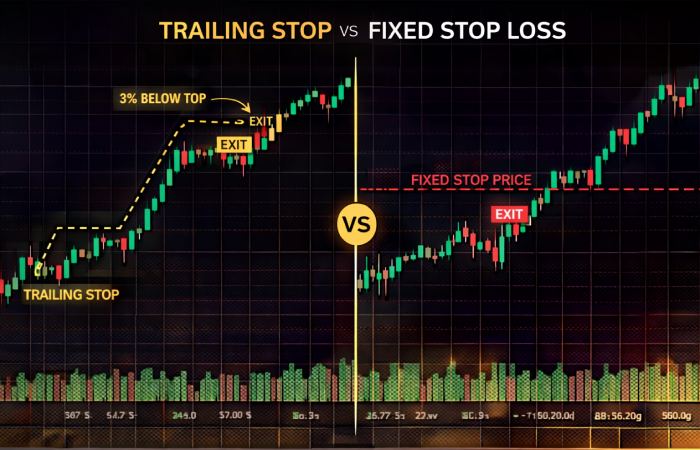
A trailing stop adjusts with price movement, unlike a fixed stop-loss that remains static.
A trailing stop is an advanced order type that sits between a regular stop-loss and an automated take-profit. Here’s the core idea:
Normal stop-loss: Fixed price. Once you set it, it doesn’t move. If BTC pumps from $60,000 to $90,000, your stop is still at $58,000.
Trailing stop: Dynamic price. It follows the market upward (for sell orders), locking in more profit as price rises — but stays put the moment price starts falling.
The result? You ride a trend as far as it goes, and exit automatically at the first meaningful reversal. You don’t need to babysit the chart.
✓ What it does well
Protects gains as price climbs. Locks in profit automatically. Works while you sleep. Adapts to market movement.
✗ What it doesn’t do
It cannot guarantee your exact exit price in fast markets. In extreme volatility, slippage may occur.
How Binance Trailing Stops Actually Work
The trailing stop rises with price and triggers automatically when the market reverses.
Binance uses two key inputs to build a trailing stop:
Activation Price (optional): The price at which the system starts tracking. If you skip this, it defaults to the current market price.
Trailing Delta / Callback Rate: The percentage reversal that triggers your order. On Spot, it’s called “trailing delta” (0.1%–20%). On Futures, it’s called “callback rate” (0.1%–10%).
The Mechanics of a Sell Trailing Stop (Long Trade)
Let’s say BTC is at $80,000 and you place a sell trailing stop with a 5% trailing delta.
BTC rises further to $100,000 → Trailing stop = $100,000 × (1 – 5%) = $95,000
BTC falls from $100,000 to $94,999 → ORDER TRIGGERS (price dropped 5%+)
Key rule: the trailing stop price only moves up when price goes up. It freezes the moment price starts falling. Once frozen, if price drops below it by the set delta, your order fires.
The Mechanics of a Buy Trailing Stop (Short Trade)
The same logic applies in reverse for short positions. The trailing price follows the market downward, and triggers a buy when price bounces back up by your chosen percentage.
The “activation price” is your safety net. If you don’t want the trailing stop to activate until BTC hits $85,000 (for example), set the activation price to $85,000. The system won’t start tracking until then — useful if you expect some initial dip before a big move.
Spot vs. Futures Trailing Stops: Key Differences
Spot and Futures trailing stops differ in execution type, parameters, and flexibility.
Feature
Spot Trailing Stop
Futures Trailing Stop
Parameter name
Trailing Delta
Callback Rate
Range
0.1% – 20%
0.1% – 10%
Order execution type
Limit order
Market order
Leverage available
No (or limited on margin)
Yes, up to 125x
Price reference
Last price
Last price or Mark price
Limit price required?
Yes
No (market order)
The most important difference: Spot trailing stops execute as limit orders. You must set a limit price. If the market drops too fast and blows past your limit, your order may not fill. Futures trailing stops execute at market price, so they almost always fill — but you lose price precision.
How to Set Up a Trailing Stop on Binance (Step by Step)
On Binance Spot
1. Go to Spot Trading
Log into Binance and navigate to the Spot trading page for your pair (e.g., BTC/USDT).
2. Select “Trailing Stop” from the order type dropdown
Click where it says “Limit” or “Market” — you’ll find “Trailing Stop” in the dropdown list.
3. Set the Activation Price (optional)
If blank, the order activates immediately at current market price. Set it only if you want to delay activation.
4. Enter your Trailing Delta (%)
This is the reversal % that triggers your order. Typical range: 1%–5% for most traders. Higher volatility assets need a wider delta.
5. Set your Limit Price
For sell orders: set this slightly below your trailing stop trigger price. For buy orders: slightly above. This is the price your limit order is placed at when triggered.
6. Enter the Amount and confirm
Review and click “Sell” or “Buy”. The order appears in your open orders as “Trailing Stop”.
Important: Set your limit price correctly
For a sell order, the limit price should be below where your trailing stop triggers — this ensures the order executes even if there’s brief slippage. If you set it too tight, the order might not fill in fast-moving markets.
On Binance Futures
1.Open the Futures trading page
Go to Futures → choose your pair (BTCUSDT perpetual is most common).
2.Choose “Trailing Stop” order type
In the order panel on the right, select Trailing Stop from the dropdown.
3.Set your Callback Rate
This is your trailing percentage (0.1%–10%). Think of it as how much reversal you’re willing to tolerate before exiting.
4.Optional: Set the Activation Price
Works the same as Spot — the trailing only starts once price reaches this level.
5.Choose “Last Price” or “Mark Price” trigger
Mark Price is safer and less prone to manipulation. Last Price reacts faster but can trigger on wicks.
Real-World Examples
Example 1: Protecting Profits in a Bull Run (Sell Trailing Stop)
You bought ETH at $2,000. It’s now at $3,500. You don’t want to sell yet — the trend looks strong — but you also don’t want to give back all your gains if it reverses.
You place a sell trailing stop with a 5% trailing delta. Here’s what happens:
Market Price
Trailing Stop Price
Status
$3,500
$3,325
Order active, tracking up
$4,000
$3,800
Trailing up with price
$4,500
$4,275
Still tracking — new high
$4,200
$4,275 (frozen)
Price dropped, stop frozen
$4,274
$4,275
TRIGGERED — Sell order placed
You entered at $2,000 and exited near $4,274. A 113% gain — all without staring at a chart.
Example 2: Entering at the Best Price (Buy Trailing Stop)
You want to buy SOL but you think it’ll dip further before going up. You place a buy trailing stop at the current price of $150, with a 3% callback rate.
SOL drops to $120, so your trailing buy price is now $123.60 ($120 × 1.03). When SOL bounces from $120 back up to $123.60 — your buy order fires. You entered near the local bottom, automatically.
Choosing the Right Trailing Delta (This Is Where Most People Get It Wrong)
Setting the wrong trailing delta is the #1 mistake traders make with trailing stops. Too tight, and normal price noise triggers your stop too early. Too wide, and you give back too much profit before exiting.
Asset Type
Recommended Delta
Reasoning
BTC (low volatility)
2%–4%
Tighter moves, less noise
ETH (mid volatility)
3%–6%
Moderate swings
Altcoins (high volatility)
5%–15%
Large wicks common
Memecoin / micro-caps
10%–20%
Extreme swings — if you even use stops
Use ATR as your guide
A practical method: look at the Average True Range (ATR) of the asset over the last 14 candles. Set your trailing delta to roughly 1.5–2× the daily ATR percentage. This accounts for normal price noise while still catching real reversals.
Advantages and Limitations
Why Trailing Stops Are Powerful
Removes emotion from trading. You don’t need to decide when to sell — the system decides based on rules you set in advance.
Works 24/7. Crypto markets never sleep. Your trailing stop stays active even when you’re offline.
Locks in gains dynamically. Unlike a fixed take-profit, a trailing stop lets you capture more upside if the trend continues.
Combines stop-loss and take-profit functions. It protects against downside and captures upside in a single order.
Limitations to Be Aware Of
Price wicks can trigger early exits. A sudden wick down — especially on low-liquidity altcoins — may trigger your trailing stop even if the broader trend is intact.
Not ideal for sideways markets. In choppy, range-bound markets, trailing stops may trigger repeatedly without clear trend direction.
Spot trailing stops are limit orders. In extreme crashes, your limit might not fill if price gaps past it.
Futures trailing stops execute at market. No price guarantee — just fast execution.
Trailing Stop vs. Stop-Limit: Which Should You Use?
Many traders confuse these two order types. Here’s the core difference:
Trailing Stop
Stop-Limit
Stop price
Moves dynamically with market
Fixed by you
Best for
Trending markets, protecting gains
Defined risk levels, fixed targets
Flexibility
High — adjusts automatically
Low — static price
Manual adjustment needed?
No
Yes (you must update manually)
Recommended when
You expect the trend to continue
You have a specific price target in mind
In short: if you want to ride a trend, use trailing stops. If you have a specific price in mind for your exit, use stop-limit.
3 Practical Trailing Stop Strategies
Trailing stops help traders capture gains while staying in strong trends.
Strategy 1: The “Set and Forget” Trend Rider
Best for: position traders who don’t watch charts all day.
Set a trailing stop with a wide delta (7%–10%) right after a confirmed breakout. Let the position run. The wide delta keeps you in during normal pullbacks but exits you if the trend truly reverses. You might give back some profit, but you capture the bulk of long moves without constant monitoring.
Strategy 2: The Tightening Ladder
Best for: active traders who want to maximize profits on strong moves.
Start with a wide trailing delta (8%) when the trade first runs in your favor. As the position becomes more profitable, cancel the order and reset a tighter trailing delta (3%–4%). This protects more of your profits as the gain grows, without cutting the trade too early at the start.
Strategy 3: The Reversal Catcher (Buy Trailing Stop)
Best for: traders who want to buy dips automatically.
When an asset you want to own is in a downtrend, place a buy trailing stop. The order tracks the price downward and triggers a buy the moment it bounces up by your callback %. You automatically buy near the bottom of the move without trying to time the exact low — because nobody can do that consistently.
Common Mistakes and How to Avoid Them
Setting the delta too tight on volatile assets. A 1% trailing delta on a memecoin will trigger on every minor wick. Always match your delta to the asset’s typical daily price range.
Forgetting to set the limit price correctly (Spot). If your limit price is set too close to the trailing trigger, a fast price drop might not get filled. Give yourself 0.5%–1% of buffer below the trigger for sell orders.
Using trailing stops in sideways markets. In consolidation, trailing stops trigger and re-trigger constantly, generating losses and fees. Wait for a trend before deploying them.
Ignoring liquidity. On thin altcoin pairs, even a triggered sell trailing stop (Spot) may only partially fill if liquidity is low at your limit price.
Confusing Last Price and Mark Price triggers (Futures). Always prefer Mark Price — it’s manipulation-resistant. Last Price reacts faster but is susceptible to temporary price spikes that don’t reflect real market moves.
Frequently Asked Questions
What happens if the market crashes so fast my trailing stop doesn’t fill?
On Spot, your trailing stop places a limit order, so if the market gaps past your limit price, the order may not fill. On Futures, it executes at market, so it will fill — but at whatever market price is available, which could include slippage. In extreme crashes (like exchange outages), no order type is immune.
Can I use trailing stops on Binance mobile app?
Yes. The Binance mobile app supports trailing stop orders for both Spot and Futures. The interface is the same — tap the order type dropdown and select “Trailing Stop.”
Does the trailing stop work when Binance is down?
Your order sits on Binance’s servers, not your device — so it remains active during internet outages on your end. However, if Binance itself experiences downtime, all orders (including trailing stops) may be delayed or paused.
What’s the difference between trailing delta and callback rate?
They’re the same concept with different names. Binance calls it “trailing delta” on Spot and “callback rate” on Futures. Both represent the percentage reversal from peak (or trough) price that triggers your order. The range is different: Spot allows up to 20%, Futures only up to 10%.
Can I set a trailing stop on my existing open position?
Yes. On Futures, when you have an open long position, you can place a sell trailing stop below the current price to protect it. On Spot, you would place a sell trailing stop for any coins you currently hold.
Is a trailing stop the same as a trailing stop-loss?
Essentially yes — “trailing stop” and “trailing stop-loss” refer to the same order type. Some traders distinguish them by use case (stop-loss = protection, trailing = also capturing gains), but mechanically they work identically on Binance.
Final Thoughts
A Binance trailing stop is one of the most underutilized tools in crypto trading. Most beginners either don’t know it exists or think it’s too complicated. But once you understand the two key inputs — activation price and trailing delta — it becomes one of the simplest and most powerful things you can add to your trading toolkit.
Use it when you’re in a trending market and you want to capture as much of the move as possible without babysitting your screen. Don’t use it in choppy sideways markets. Always match your trailing delta to the asset’s volatility level. And never forget to set a sensible limit price on Spot orders.
The best traders aren’t the ones who are always watching — they’re the ones who’ve set up smart rules that work for them automatically. Trailing stops are a big part of how they do it.
Marketing is a crucial component of business-to-business (B2B) companies because it boosts sales by helping you reach your target customers. In addition, promotional efforts can also raise brand awareness, which allows you to stand out from your competitors who sell similar offers. Furthermore, you can use this initiative to cultivate strong customer relationships, leading to repeat business and referrals to qualified leads.
However, most marketing campaigns will cost you a lot of money. Your business needs to spend on advertising and marketing campaigns so you can attract more prospects and increase sales. Aside from that, you won’t even know if your efforts generate the best results, so you might continue to waste funds on the same ineffective initiatives.
Fortunately, this article provides five tips for minimizing your B2B marketing costs without sacrificing excellent results.
Table of Contents
1. Targeting The Right Customers
You can spend lots of funds on marketing, but you’ll waste your efforts if you’re not targeting the right audience. Knowing what will work best for your business isn’t accessible if you have too many options. As a result, you will waste your time and financial resources on poor tactics that don’t bring in new customers or help you retain existing ones.
When targeting customers, you must look at your customer base or database and break them down into segments based on their demographic and psychographic profiles. Also, remember that you must distribute segments based on similar client characteristics, such as age group and business needs. After that, use B2B content syndication to identify prospects in purchase mode so you can save funds in chasing inactive and out-of-market buyers.
2. Finding The Most Effective Marketing Channels
The key to an effective marketing campaign is identifying the right audience and effectively communicating with them. The challenge is that when you’re not using the proper marketing channels, you might be discouraging audience engagement. So, you must know what your target customers frequently use to communicate with their favorite brands. Once you do so, you can introduce your offers to them.
For example, if you’re advertising on Facebook, but your target market is more likely to be on Instagram or Pinterest, then use those channels instead of Facebook ads alone. This strategy boosts brand reach to ensure more online users see your content. Also, you will avoid harming your reputation by showing up as irrelevant ads in front of people who aren’t interested in what you sell.
3. Repurpose Previous Content
Repurposing previous content is a great way to leverage your efforts, increase brand awareness and improve your search engine rankings. With this strategy, your customers will feel like you care about them more, knowing that you’re willing to go through the trouble of bringing back old content. In turn, you will build trust and loyalty between you and your customers, which is essential for ensuring the growth of your B2B company.
For instance, if you have an old blog post well received by your web visitors, you can turn it into a video or infographic. Next, you can take that content and publish it as a guest post on another site to reach a larger target audience without crafting other content. Thus, your marketing team can focus on promotional initiatives to encourage your clients to buy your products or services.
4. Recognize High-Performing Marketing Employees
Your top-performing employees need recognition for doing a job well. When you don’t recognize high performers to motivate them to continue performing well, they will likely leave soon after that. As a result, you need to hire new employees and repeatedly undergo the training process. Aside from that, you will miss out on those employees’ knowledge and experience when promoting your brand.
To keep costs in check, you must recognize the people producing excellent results. For example, you may send out an email thanking them for all they’ve done throughout the month and letting them know that you appreciate all their hard work. Alternatively, you may invite them to meetings with senior management to discuss how they contribute to the organization’s success.
5. Nurture Relationship With Customers
While it can be tempting to focus on acquiring new customers, nurturing your existing customer base is essential. This innovative marketing strategy includes activities after the initial sale to deepen the relationship between your organization and your clients. As a result, you will invite them to return to your store, which increases your revenue.
To nurture customer relationships, you should provide excellent customer service by offering incentives for repeat purchases. Next, you may build a sense of community among clients by sharing valuable information about how they can help each other. After that, you should also send personalized messages via email to receive more responses from them while making them feel special.
Key Takeaway
As a modern B2B owner, you must prioritize brand promotions without spending too much money and affecting results. Therefore, you should consider following these five strategies in reducing B2B marketing expenses. Once you do so, you can reach more customers, boost employee engagement, and create a positive brand image.
Cost-Saving Options: Print orders, in many cases, are now more specialist, high-end publications involving more creative differentiation as a result of digital replacing traditional media as the dominant format for mass consumption. For print customers, this can make things more difficult by expanding their options and possibly increasing their costs as well.
However, a beautiful print doesn’t have to be expensive. With a little knowledge and the right level of help from your magazine printing company, you may be able to find the simplest parts of your publication where prices can be cut. This will allow you to put money toward the parts that really make a difference.
The suggestions outlined in this article are meant to make you a more knowledgeable print buyer who is better equipped to deliver exceptional print work without hurting your profit margin.
What you’ll learn in this guide
Magazine printing costs in the UK depend on a handful of key decisions — quantity, page count, paper weight, printing method, binding, and finishes. Change any one of them smartly, and you can cut your cost per copy by 30–60% without touching the quality your readers see. This guide breaks down every lever, in plain English.
Table of Contents
Why Magazine Printing Costs Vary So Much in the UK
You can get quotes for ‘the same magazine’ from two UK printers and find prices that differ by 50% or more. That’s not one printer ripping you off — it’s because magazine printing costs are driven by several independent variables, and small changes to any one of them ripple across the entire bill.
Fixed setup costs spread across all copies — more copies = cheaper per unit
Very High
Page Count
More pages = more paper, ink, press time, and handling
High
Printing Method
Digital suits short runs; litho (offset) gets cheaper at 1,000+ copies
High
Paper Stock & GSM
Heavier, coated paper costs more — and increases postage weight
Medium
Binding Method
Saddle stitch is cheapest; perfect binding adds cost but gives a spine
Medium
Finishing & Extras
Lamination, spot UV, foiling — each adds cost; most are optional
Low–Medium
1. Print More Copies Per Run (or Combine Runs)
This is the most powerful cost lever in magazine printing — and the most misunderstood. Fixed setup costs remain the same regardless of quantity. Every magazine job requires artwork checks, press setup, calibration, and initial waste during make-ready. Those costs are spread across every copy you print. So the more copies in a single run, the cheaper each one becomes.
Print Run Size
Cost Per Copy (approx.)
Best Method
Verdict
1–50 copies
£3–£8+ per copy
Digital
High cost
100–250 copies
£1.50–£3 per copy
Digital
Moderate
500–1,000 copies
£0.70–£1.50 per copy
Digital or Litho
Good value
2,000–5,000 copies
£0.30–£0.80 per copy
Litho (offset)
Strong savings
10,000+ copies
£0.15–£0.40 per copy
Litho (offset)
Best unit cost
Note: Prices vary significantly by specification. Always request tailored quotes for your exact project.
Cost-Saving Tip: Batch Multiple Issues
If you publish quarterly, consider printing two or three issues at once during the same press run. Many UK printers will hold stock and dispatch in batches — this reduces your unit cost while avoiding large immediate storage needs.
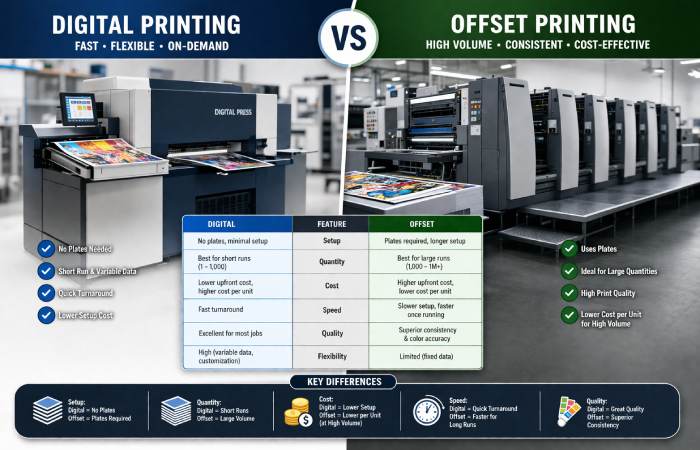
2. Choose the Right Printing Method: Digital vs. Litho
Digital printing suits short runs, while litho printing is more cost-efficient at scale.
UK magazine printers use two main production methods, and choosing the wrong one for your volume is one of the most common — and costliest — mistakes.
Digital printing is cost-effective for short runs, offers fast turnaround, and allows personalisation. Files go straight from your PDF to the press — no printing plates needed. Digital is ideal for runs under 500–1,000 copies, test prints, personalised editions, or when you need a fast turnaround.
Litho (Offset) Printing
Litho printing is better for high-volume printing, consistent colour, and premium finishes. Plates are made first (a setup cost), then ink is applied at high speed. The per-unit cost drops sharply as volume increases, making it the go-to for established publishers printing 1,000+ copies per run.
Factor
Digital Printing
Litho Printing
Best run size
Under 1,000 copies
1,000+ copies
Setup cost
Low / none
Higher (plates needed)
Cost per unit at volume
Stays relatively high
Drops significantly
Turnaround time
Fast (2–5 days typical)
Longer (5–15 days)
Personalisation
Yes (variable data)
Not practical
Colour consistency
Good
Excellent
Premium finishes
Limited
Full range
Which is right for you?
If you’re printing fewer than 500 copies, digital is almost always cheaper. Above 1,000 copies, get quotes for both and compare total cost — not just unit cost. Factor in turnaround time too, as faster digital delivery may save money on time-sensitive issues.
3. Optimise Your Page Count
More pages increase cost because each extra page requires additional paper, ink, and press time. A magazine with more pages uses more sheets, raising material costs. It also takes longer to print, fold, collate, and bind.
The key rule to know: magazine pages must always be in multiples of four. That’s because pages are printed on large sheets that are folded down. A 36-page magazine, for example, is not possible with saddle stitch — you’d need 32 or 40 pages.
Cost-Saving Tips for Page Count
• Audit every issue for content that can move online — a QR code linking to extra content can cut 8–12 pages per issue. • Tighten your design layouts to reduce page count. • Reduce full-page ads; use half-page formats for the same visual impact with fewer pages. • Always spec to a multiple of four — unnecessary extra pages are pure waste.
4. Choose Paper Wisely: GSM, Coating & Weight
Paper choice affects print quality, cost, and overall magazine feel.
Paper is one of the biggest cost components in any print job — and it also affects postage, which can easily double your distribution cost if you’re mailing copies. A cost-effective, professional-looking magazine typically uses 80–100gsm silk for internal pages and a 200–250gsm silk cover.
Paper Type
Typical GSM
Best For
Cost Level
Offset / Uncoated
80–90gsm
Text-heavy, community pubs
Lowest
Silk / Satin
90–130gsm
Best all-round — sharp text + good images
Low–Mid
Gloss coated
90–150gsm
Photo-heavy, brand magazines
Mid
Premium heavyweight
150–170gsm+
Luxury / art publications
High
Watch Your Postage Costs
If you mail your magazine, paper weight directly affects your distribution cost. A switch from 130gsm to 100gsm internal pages can reduce copy weight enough to drop a Royal Mail pricing band — potentially saving hundreds of pounds per mailing. Always weigh a dummy copy before finalising your spec.
5. Pick the Right Binding Method
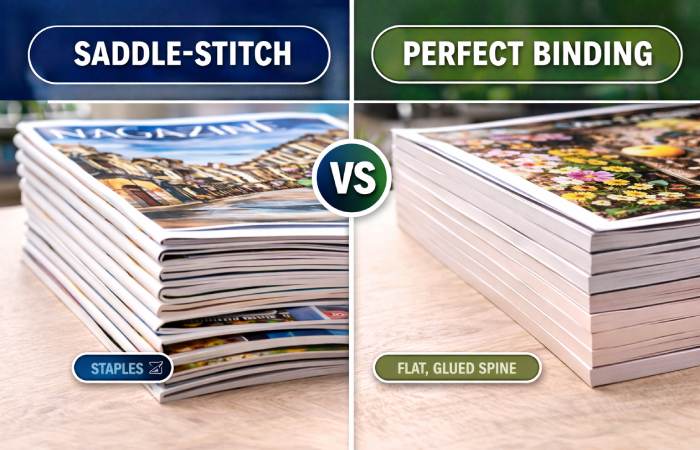
Saddle stitch is cost-effective, while perfect binding offers a premium finish.
Binding is one of the clearest places to save money — or waste it. There are two options that cover 90% of UK magazine projects.
Saddle Stitch (Staple Binding)
Saddle stitching is the least expensive of all binding methods. The printed pages are stapled through a fold and trimmed to size. It works best for magazines up to around 48–64 pages. Publications bound with saddle stitch can lay flat when opened, which is beneficial for many types of content. The main limitation: no printable spine area.
Perfect Binding
Perfect binding glues pages to a square spine — the format used for most paperback books. It gives your magazine a premium, shelf-worthy look and a printable spine. However, perfect binding costs more than saddle stitch — in design, materials, production, and often shipping.
Feature
Saddle Stitch
Perfect Binding
Page count range
8–64 pages
28–700+ pages
Cost
Lowest — best for budget
Higher
Printable spine?
No
Yes
Lies flat when open?
Yes
No
Production speed
Faster
Slower
Best for
Regular issues, newsletters
Annual / prestige editions
6. Skip (or Simplify) Expensive Finishing Options
Finishing options — lamination, spot UV varnish, embossing, foiling — can add 20–40% to your print bill. Here’s a quick guide to what’s worth it and what you can skip.
Finish
What It Does
Cost Impact
Worth It?
Gloss lamination (cover)
Shiny, vivid, protective coating
Low addition
Usually yes
Matt lamination (cover)
Subtle, sophisticated finish
Low addition
Usually yes
Spot UV varnish
Glossy highlights on specific areas
Moderate
Special editions only
Embossing / debossing
Raised or recessed design on cover
High addition
Luxury only
Foil stamping
Metallic finish on specific elements
High addition
Luxury only
Key Rule on Finishes
Cover lamination is almost always worth it — it protects the cover, enhances colour, and costs very little extra. Everything else (spot UV, embossing, foil) is for special or premium editions where the wow factor justifies the budget. A well-designed cover on matt-laminated 250gsm silk will look more premium than a mediocre design with expensive foiling.
7. Choose a Cost-Efficient Size
Magazine size directly affects how efficiently paper is used — and wasted. Standard paper sizes (A4, A5) are cut from standard sheet sizes with minimal waste. Custom or unusual dimensions often require oversized sheets that are trimmed down — you’re paying for paper you’re throwing away.
A4 (210 x 297mm) — The most common format. Best value for full-content magazines. Printers are fully set up for it, reducing setup time.
A5 (148 x 210mm) — Roughly half the paper cost of A4 for the same number of pages. Great for community newsletters, mini publications, or inserts.
Custom sizes — Can look distinctive but typically cost more due to paper waste and additional setup. Only worth it if the format is a core part of your brand identity.
8. Plan Ahead: Lead Time Saves Money
Faster turnaround may increase cost due to prioritised scheduling, production adjustments, or expedited logistics. Longer lead times generally help maintain standard pricing. If you can give a printer 10–15 working days instead of 3–5, you’ll typically pay standard rates rather than rush rates.
Set your distribution date first — work backwards from when readers need their copy.
Allow 10–15 working days for print production. More for litho runs; digital can be as fast as 2–5 days at standard rates.
Set your artwork deadline accordingly — add 3–5 days for proofing and corrections before submitting to press.
Book your print slot in advance — for busy periods (Christmas, trade show season), booking weeks ahead secures standard pricing and your slot.
9. Consider a Digital / Print Hybrid Model
One of the most effective cost-saving strategies for 2026 isn’t about printing at all — it’s about printing fewer copies more strategically.
Many UK publishers are moving to a hybrid model: a smaller print run for subscribers, premium readers, or display copies — paired with a free digital edition (PDF, Issuu, or web version) for general distribution. This lets you maintain the prestige and tactile experience of print while dramatically reducing your unit cost by printing at a more economical quantity.
Print 500 premium copies for subscribers and key distribution points.
Distribute a free digital edition via your email list or website.
Use digital analytics to understand which content is most popular — then invest that insight back into your print edition.
10. Consider Mono (Black & White) Interior Pages
If your magazine is predominantly text-based — think trade publications, community newsletters, literary magazines — a fully colour interior is not always necessary. Choosing mono (black and white) interior printing is perfect for text-heavy content and can significantly reduce per-page printing costs.
A common middle-ground approach: use full colour on the cover and the first few editorial pages (which readers see first), then switch to mono for text-heavy sections. This gives a professional impression while keeping interior page costs down.
One reprint due to an artwork error can cost more than all the savings you’ve made elsewhere. Here’s a quick checklist of what UK printers need from your files:
Save as a single multi-page PDF (saddle stitch) or separate cover and inner PDFs (perfect bound).
Use CMYK colour mode — not RGB. RGB files will be auto-converted, often with noticeable colour shifts.
Set image resolution to 300 DPI minimum for all photos and graphics.
Include a 3mm bleed on all edges.
Keep all important text and images at least 3–5mm inside the trim edge.
Embed all fonts in your PDF to avoid substitution issues.
Set black text as 100% K only — not rich black — for crisp, readable text.
12. Always Get Multiple Quotes — and Know What to Compare
UK magazine printing prices vary enormously between suppliers. Comparing quotations helps identify the most efficient option. But you need to compare like-for-like — a quote that looks 30% cheaper may exclude VAT, delivery, or use a lighter paper stock.
When requesting quotes, always specify:
Finished size (e.g., A4, A5, custom)
Total page count (including covers) — confirm it’s a multiple of four
Cover paper weight and coating (e.g., 250gsm silk, matt lamination)
Interior paper weight and type (e.g., 100gsm silk)
Binding method (saddle stitch or perfect bound)
Print quantity
Delivery requirements (address, timescale)
Whether the price includes or excludes VAT and delivery
Request Quantity Breaks
When getting quotes, always ask for pricing at two or three different quantities — e.g., 250, 500, and 1,000 copies. You might find that printing 500 copies costs only marginally more than 250, making the extra copies essentially free. This is common with litho printing where setup costs dominate.
UK Magazine Printers Worth Comparing
Here are well-regarded UK-based (and UK-serving) magazine printers to include in your quote process. Always verify current pricing directly with each supplier.
Printer
Best For
Notes
Mixam UK
Short–medium runs
Online instant quoting across a wide range of specs. Offers standard and expedited services.
HelloPrint UK
Competitive online pricing
Offers glossy, silk, and offset paper options. Well-suited for marketing-led magazines.
Ex Why Zed
Independent & arts publishers
Strong reputation among independent publishers. Good range of binding options with quality guidance.
Gemini Print Solutions
Trade & volume with fulfilment
Services include storage, packing, addressing, and delivery. Good for publishers who need fulfilment alongside printing.
YouLovePrint
Simple UK online ordering
Multiple binding options. Clear spec guidance. Good option for smaller independent publishers.
The Sustainable Printworks
Eco-conscious printing
No VAT or delivery charges. Monochrome printing option for text-heavy content. Specialises in community magazines.
Your Cost-Saving Checklist: Quick Wins at a Glance
Print the right quantity for your method. Under 500 copies: go digital. Over 1,000: get litho quotes.
Batch issues together if you publish quarterly or less frequently to reduce setup costs.
Keep page count to a multiple of four and audit every issue for removable content.
Choose silk 90–100gsm for interior pages — the sweet spot of quality and cost.
Use saddle stitch for issues under 64 pages. Only use perfect binding when your content demands it.
Cover lamination yes; spot UV, foil, and embossing only for special editions.
Stick to A4 or A5. Custom sizes cost more due to paper waste.
Give printers 10–15 working days at standard rates whenever possible.
Get quotes from at least three UK printers using the same full spec.
Consider a hybrid model — smaller premium print run plus free digital edition.
Consider mono interior pages for text-heavy publications.
Frequently Asked Questions
How much does it cost to print a magazine in the UK?
It depends heavily on your specification, but as a rough guide: a 32-page A4 magazine on silk paper with saddle stitch binding might cost £0.80–£1.50 per copy for 500 copies with digital printing, or around £0.40–£0.70 per copy at 2,000+ copies with litho. Always request tailored quotes for your exact spec.
Is VAT charged on magazine printing in the UK?
Many printed publications — including magazines, newspapers, and books — are zero-rated for VAT in the UK. However, this depends on the specific nature of the product. Promotional publications that are primarily advertising may be subject to standard rate VAT. Always confirm the VAT position with your printer and HMRC guidance.
What is the minimum quantity for magazine printing in the UK?
Some UK printers will print as few as 100 copies in a single run. For digital print-on-demand, some suppliers will print single copies. The trade-off is always cost per unit: small runs cost significantly more per copy.
What’s the most cost-effective paper for a UK magazine?
For most UK magazines, 90–100gsm silk for interior pages and 200–250gsm silk with matt lamination for the cover is the sweet spot. It looks highly professional, photographs reproduce well, and the cost is lower than heavier-weight stocks.
Can I reduce printing costs by using black and white interior pages?
Yes — significantly. Mono (black and white) interior pages cost considerably less per page than full colour. If your magazine is text-led — a trade publication, community newsletter, or literary journal — mono pages with a colour cover is a very cost-effective combination.
Should I use a local printer or an online UK printer?
Both have merits. Local printers offer easier communication, the ability to see samples in person, and potentially faster turnaround for urgent jobs. Online UK printers typically offer lower prices through automated processes and volume discounts. For your first run with any new printer, getting a physical proof first is always recommended.
Final Thoughts
Cutting magazine printing costs in the UK doesn’t mean settling for something that looks cheap. It means making smart decisions about the variables that affect your bill — and knowing which ones deliver genuine savings versus false economies.
Start with quantity and method (the biggest levers), then work through paper, binding, and finishes. Build lead time into your production calendar. Get multiple quotes using a precise, consistent specification. And always proof before you print.
Do all of that, and there’s no reason you can’t produce a magazine that looks every bit as good as a newsstand title — for a fraction of what you’d naively spend.
Disclaimer: Prices quoted in this article are approximate guides only and subject to change. Always request up-to-date quotes directly from printing suppliers for your specific project. This article does not constitute professional printing or financial advice.
In the realm of digital marketing, you’ve probably heard that content is king. But in terms of content, video is considered the most effective type. This makes video the king of digital marketing.
As a powerful asset, businesses of all sizes should be using video to its fullest potential. If you need the facts, then here are some of the biggest reasons why video should be unequivocally used in your overall marketing strategy.
Table of Contents
1. Video Commands Attention
In a busy digital world, so many things are fighting for a consumer’s attention. And there’s only so much attention to go around. Being able to capture a user’s attention in just seconds can be difficult. However, an effective video can help you do just that.
Since video uses both aural and visual stimuli, it’s far better than static advertisements in capturing a user’s attention. While a user may stop to look at creative photos, videos are known to hold attention up to 5x more than still photos.
That said, the first few seconds of your video should be creative and compelling enough to make a user stop scrolling and focus on your content. In this case, you want to hire an expert video agency like Rockmans Creative Media to create high-end business video content that instantly attracts attention.
2. Video Can Explain Things Better
If a picture is worth a thousand words, how much more does a video convey?
A video can provide more information than text or photos when launching a new product or service. By showing users how your services or product works, they’re more likely to have a better understanding of the products or services. You can even add subtitles to the video to help make it easier to understand.
In addition, if you’re trying to explain difficult concepts, videos can make it easier. For instance, creating animated videos can bring these difficult concepts to life that no live video or text can. Animated videos are the perfect combination of simplicity and entertainment. Plus, they work.
3. Video Improves Leads, Conversions, And Sales
Video can significantly improve your business’s revenue and bottom line. Video is a brilliant investment that helps in generating leads. Over 80% of marketers revealed that they have experienced increased leads when they’ve included videos in their marketing strategy.
Furthermore, simply adding a product or service video on your website’s homepage or landing page can boost conversions by up to 80%. Over 80% of marketers also said that video positively influences sales. Since videos can increase users’ understanding of their services or product, it impacts their buying decision. A report shows that more than 70% of people who watched an explainer video subsequently bought the product or service.
4. Google Loves Videos
YouTube is one of the most popular platforms on the web that primarily caters to video content. But what’s best is that Google owns YouTube. This is extremely beneficial for digital marketers in improving their SEO rankings.
In general, a key part of every digital marketing strategy is optimizing search engines, primarily Google. Since Google owns YouTube, there’s a significant increase in how much videos impact your search engine ranking. Google prioritizes ranking pages with video, especially one from its website, for a myriad of keywords. This means that pages with videos are more than 50x more likely to rank in the top results than those without one.
Plus, videos tend to go viral, racking up staggering amounts of backlinks, traffic, and other SEO-related requirements with way less effort than tactics such as guest posting.
5. Videos Are Shareable
Highly shareable on different platforms, videos consistently outperform other content, particularly text-based posts, on social media platforms. A report shows that video is up to 40x more likely to be shared on social platforms than other content. This is because the average human processes visuals faster than text.
Besides, social media also encourages video content with features like live video, stories, and reels. This provides you with more opportunities to showcase your brand and engage your customers. In addition, followers who share your videos on their profiles can significantly boost your marketing efforts, introducing you to new potential customers and ultimately increasing brand awareness. Plus, when users share your videos, it signals to others that you’re a reliable and trustworthy brand.
Take Away
All this says one thing– video is the present and the future of the digital marketing space. So, if you’re not yet using video marketing, you need to start immediately. Video marketing is one of the most effective ways to reach your target audience in this digital area and provides the most impact on your viewers, ultimately helping your bottom line.
Google plays a vital role in local businesses reaching out to the target market. It is easier now to look for products and services with one click. This looks like an opportunity for new companies to level up their ways to expand the business. It is as important as setting a budget for SEO services to get started in enjoying more of their benefits.
Not adapting to SEO will make you lose potential customers. However, beating the competitors urges you to be extra relevant to withstand the local search. People are now conscious of what they are going to buy, even though it is done online.
Table of Contents
Describe Local SEO
Local SEO is made for small businesses who are wishing for more traffic on search engines. This tool helps to improve brand visibility online which is extremely possible nowadays.
Perhaps a potential buyer is looking for products and services similar to what your business offers. Consequently, local SEO will get you in the best position so that prospects will find your business easily.
It works with search engines to build a good reputation for a certain business. Beforehand, ensure whether the firm is SEO-optimized to appear in local results.
An Ultimate Guide For Local SEO
Here is a list of tips you can consider in using SEO for local businesses:
1. Take Advantage of Google Tools
One is Google My Business which works to boost your business on local searches. When a local entity is Google-optimized, it will be easier to infiltrate the local search and reach out to potential shoppers.
Also, customers who share reviews are a cost-efficient way to boost your brand.
2. Use Social Media
Connect your business to social media platforms and engage with the audiences. Make sure to include clickable sites to bring customers to your official website.
Use internal links reliable to the business. There are SEO tools you can depend on to help boost your ranking.
3. Set Up Available Contacts
It is useless to appear online with an inaccessible phone number and address. Search engines will require a constant online presence to keep you on top. So, make it easier for potential customers to find your business.
The citation must also be clear and consistent, meaning you should avoid missing words and numbers. Google may get in trouble locating your business with the wrong listings.
Set a location that is easy to navigate using Google Maps.
4. Execute Regular Audits
Managing a business online takes continuous work to fulfill goals. Inspect for possible errors and inaccuracies that could affect the search ranking. Double-check the links and other citations to ensure the website is functioning well.
This can tell if making changes is necessary for the business.
5. Improve Content Quality
A quality blog post contains a meta description, headers, and URLs which are vital for beating search engines. Writing content must also include keywords that may easily appear in local searches.
Focus on local audiences in writing blog posts. This strategy will help you persuade the target market a lot easier.
Adding inbound links will boost your domain authority using local SEO. It will extend your network with the right local manufacturers to partner with.
6. Be Mobile-Friendly
Buying stuff online has become the new norm in the past year. Accordingly, making use of mobile phones to search for products is susceptible for most shoppers.
Building a mobile-friendly website is a logical step to cater to the target audiences. It is also easier to gain prospects via phone which will lead to sales.
7. Build Local Community
Lastly, brand awareness will happen quickly with the help of the community. Start to engage with organizations that will benefit your business. It will increase your search scope within the region.
Why Invest in SEO Tools?
Local SEO has to offer different tools to meet every business need. They all have a single purpose which is to boost your search engine ranking.
These are practical tools to keep your business well-off. It is then easier to compete with other companies to showcase products and services via digital sources. As evidence, almost 50% of consumers browse local searches to buy items.
Here are other benefits of SEO for local businesses:
SEO Guarantees Data Accuracy
SEO listings are verified by Google to promote trust in online searches. Adding proper citations will also bring your business to the top of the search engine ranking.
SEO Can Boost Visibility
SEO includes backlinking with the use of keyword research as an anchor text containing a link to your website. Once a potential client clicks the link, there are chances of converting traffic.
SEO Attracts More Investors
Building relationships with other local companies is possible with SEO. This is necessary to quickly grow a business with minimal effort in the long run.
SEO Helps Generate Feedback
Once people find out about your business via local searches, they have no choice but to leave a comment. It could be a marketing strategy to reach out to more clients.
Conclusion
To summarize, local SEO must be reliable to what your business offers. It contributes a lot to online businesses in terms of creating quality content with a higher rank in the search engine. Follow the above tips to obtain the full benefits of SEO for any local enterprise.
Have you ever wondered where a popular meme originated? Everyone on social media knows memes and there are plenty to go around.
Do you know why people make memes? Why are they popular? Or what is the history of memes?
Explore the stories behind your favorite memes with us in this article. Keep reading!
Table of Contents
The History of Memes
A meme is an image, video, or piece of text that is copied and spread by Internet users. Richard Dawkins was the one who coined the name meme in his 1976 book The Selfish Gene.
Dawkins described memes as a “unit of cultural transmission” that you can forward from one individual to another.
The first major wave of memes began in the early 2000s with the advent of social media platforms like Myspace and YouTube. These platforms allowed users to easily share images and videos, which led to the spread of popular memes like “Lolcats” and “Rickrolling.”
How Memes Have Evolved Over Time
Memes are ideas, behaviors, or styles that spread from person to person within a culture. A meme carries cultural ideas, symbols, or practices, which you can forward from one mind to another through writing, speech, gestures, rituals, or other imitable phenomena.
Over time, memes have evolved to become an integral part of our online culture. They are often used to convey humorous or insightful messages and can be an effective way to communicate with others.
The Most Popular Memes Throughout History
The most popular memes typically start as inside jokes among a group of people and then spread to the wider internet.
The first known meme was the “Dancing Baby” animation, which went viral in the early days of the internet. Since then, there have been hundreds of popular memes, ranging from the “Gangnam Style” dance to the ” Distracted Boyfriend” meme.
While some memes are simply entertaining, others can be more meaningful. In recent years, memes have been used as a way to spread awareness about important social and political issues.
For example, the “Me Too” movement against sexual harassment and assault gained traction in part because of the widespread sharing of the “Me Too” meme.
Impact of Memes on Society
Since their inception, memes have been an integral part of online culture. They are often used to convey a message or share a joke and are often Leo-related. While some memes are harmless fun, others can have a more serious purpose.
In recent years, memes have been used as a tool for political commentary and social activism. Memes have also been known to start internet-based debates and movements.
With their ability to reach a large audience quickly, memes have the potential to impact society in a positive or negative way.
Creating Your Own Meme
If you want to create a successful meme, you need to have a good understanding of what makes a meme successful in the first place.
Some factors that can affect a meme’s success include its overall quality, how relatable it is, how easy it is to understand, and how funny it is. Even a restaurant logo design can become a successful meme!
Enjoy Memes Today
They are often funny, relatable, and make us think. The history of memes has evolved over the years and will continue to do so. They are a reflection of our society and our values.
Keep up with the latest memes and share them with your friends!
Did you find this article helpful? Check out the rest of our blogs!